Skip to content


Travertine and marble are the two stone materials that appear most often in luxury interiors — and the two that generate the most questions from clients and designers alike. Which is right for the space? How do they age? What does caring for them actually involve? This guide answers all of that, with a look at the stone-topped pieces we carry at Eichholtz Las Vegas.
Stone brings something to a room that no other material does. The grain is unique to each slab, the weight is substantial, and the patina improves over time rather than degrading. Eichholtz has worked with travertine, marble, and limestone across its collection for decades — not as a trend, but as a material vocabulary that feels genuinely permanent in a room. Understanding the difference between the two materials helps you choose the right piece for the right place.
No two stone tops are alike — the veining and tone vary by slab, which is part of what makes a stone piece feel personal rather than product-like.
What travertine actually is
Travertine is a form of limestone. It forms near hot springs and limestone caves, where calcium carbonate deposits build up in layers over thousands of years. The result is a material with a warm, earthy palette — cream, ivory, walnut brown, and taupe are the dominant tones — and a characteristic surface texture that comes from natural voids in the stone. Those voids are part of its appeal. Filled travertine has the pits sealed with grout or resin, producing a smooth surface. Unfilled travertine leaves them open for a more tactile, organic quality.
Most Eichholtz pieces use filled and honed travertine — smooth to the touch, matte in finish, and very neutral in color. The Coffee Table Amara Low is a good example: a block of travertine on a minimal form, where the material does all the work. The neutral tones mean it works with almost any color scheme, from warm cream-and-brass rooms to cooler stone-and-linen palettes.
- Warm tones. Cream, ivory, sand, and walnut brown make travertine easy to place in almost any interior palette.
- Honed surface. The matte finish is less reactive to light than polished stone, and it conceals minor surface marks well in day-to-day use.
- Substantial weight. Dense and grounded — the mass of a travertine piece reads as architectural rather than decorative.
- Moderate porosity. More absorbent than granite. Seal on arrival and reseal annually in high-contact applications like dining tables.
What marble actually is
Marble is a metamorphic rock — limestone that has been subjected to intense heat and pressure over millions of years. That process produces the veining that makes marble immediately recognizable: dramatic lines in white, grey, gold, or black running through the base stone. Unlike travertine, marble is quite dense in its polished form, and the veining is structural rather than surface-level — it runs through the entire slab.
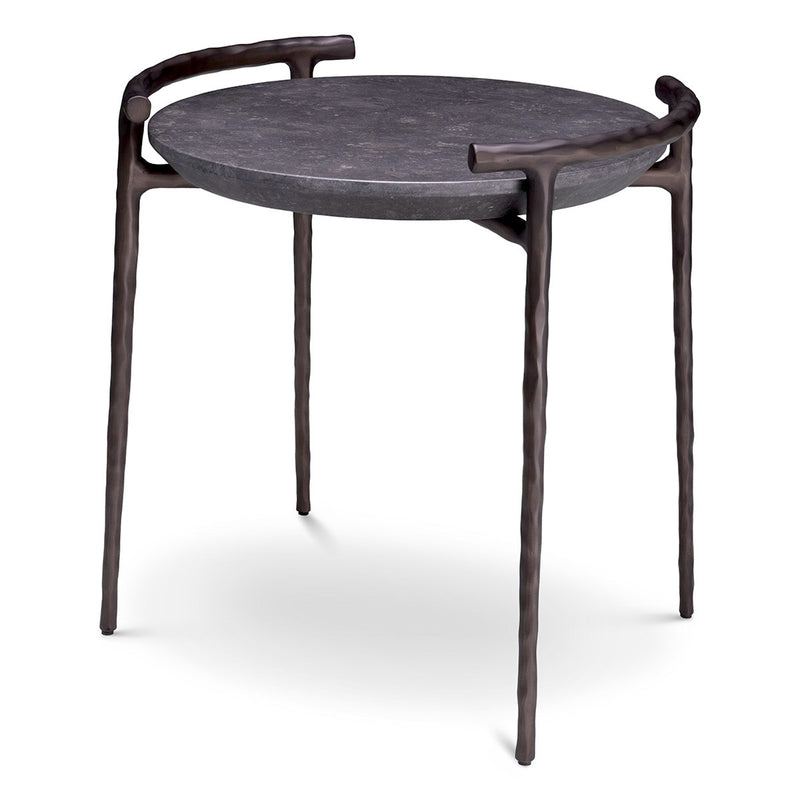
Every marble piece is genuinely unique. The Side Table Arca uses a gray marble with veining that varies from piece to piece. Two Arca tables placed side by side will look related but not identical. This variation is a feature, not a flaw. The table you receive is the specific slab that was selected for it, with its own character.
Marble is more sensitive to acid than travertine. Red wine, citrus, and most household cleaning sprays will etch a polished marble surface — not stain it, but leave a dull mark where the acid reacted with the calcite in the stone. Etching can be addressed by a stone care professional, but it is easier to prevent than to reverse. A marble coffee table in a working family room is a different commitment than the same table in a more formally used living room.
Where each stone works best
The practical question is usually where to put each material, not which one is objectively better. Both belong in a luxury interior — the choice comes down to function and placement.
For coffee tables, travertine is typically the more forgiving choice. The honed matte finish does not show minor scuffs or water rings the way polished marble does, and the warm neutral tones make it easy to style around. The Coffee Table Amara Low is specifically designed for this role. The proportions are low to the ground, the form is minimal, and the travertine does the talking.
For side tables, marble earns its place. A side table typically holds a lamp, a drink, and a book — it absorbs less daily impact than a coffee table, which reduces the etching risk significantly. The Side Table Arca pairs gray marble with a bronze base. The combination reads warm despite the cool stone: the bronze offsets the grey veining, and the result is a piece that reads as refined rather than cold. It works in living rooms that lean toward natural materials — warm wood floors, linen upholstery, brass or bronze lighting.
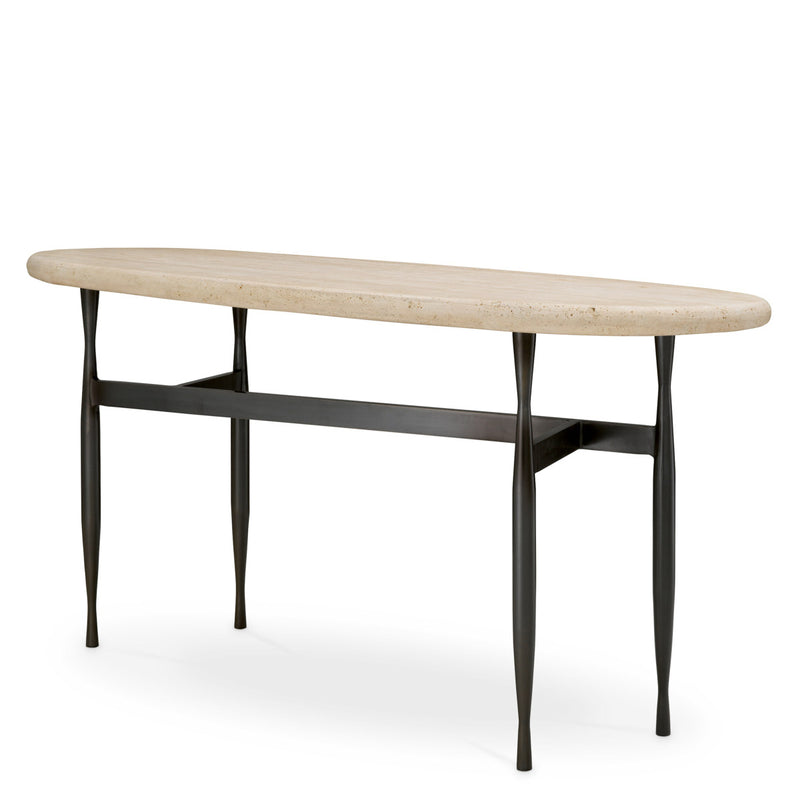
For consoles, stone is a natural fit. Console tables hold objects rather than absorb impact, which makes the porosity and etch considerations less pressing. A travertine console in an entry hall carries a visual weight that works in formal rooms. The Console Table Palermo — a 63-inch bronze-and-travertine console — is exactly that kind of piece. In an entry, it establishes the material register of the room before a guest reaches the living space. Behind a sofa, it creates a horizontal plane that anchors the seating group and provides surface for lighting and objects.


Caring for stone
Stone maintenance is straightforward once the basics are in place. The goal is to limit what gets into the stone and to neutralize the surface before it reacts.
- Seal on arrival. Travertine and marble both benefit from a penetrating stone sealer applied before the piece enters service. Most are already sealed from the factory, but a fresh coat when the piece is new adds insurance.
- Blot, do not wipe. Liquid spills on porous stone should be blotted with a clean cloth rather than wiped. Wiping moves the liquid further into the stone rather than lifting it.
- pH-neutral cleaners only. Vinegar, citrus-based products, and most standard multi-surface sprays are acidic and will etch marble. Use a stone-specific cleaner or plain warm water.
- Felt pads under objects. Hard objects dragged across a honed travertine surface can scratch. Felt pads under vases and candle holders prevent this without any visual intrusion.
- Reseal annually. For highly used surfaces — dining tables, consoles with daily handling — a once-yearly reapplication of penetrating sealer keeps the stone performing well over time.
A practical note on delivery
Stone furniture is heavy. The Coffee Table Amara Low weighs 121 pounds. The Console Table Palermo is 86 pounds. These pieces ship on pallets with white glove delivery to the room of choice — standard residential delivery does not apply. We coordinate the logistics as part of the order.
For clients outside Las Vegas, Eichholtz in-stock pieces ship from the warehouse network, with typical delivery in two to four weeks. That is substantially faster than made-to-order stone, which runs twelve to eighteen weeks in most cases, and faster than comparable pieces from most other sources. If a specific finish or size is required that is not in stock, the lead time extends accordingly — worth asking before committing to a project timeline.
Choosing with confidence
The practical difference between travertine and marble comes down to how a surface will be used. Travertine is warmer in tone, more forgiving of daily contact, and easier to maintain without professional intervention. Marble is denser, more dramatic in its veining, and right for placements where the impact risk is lower — side tables, consoles, accent pedestals. In a well-designed room, both materials can coexist across different pieces. The key is matching the material to the use case rather than the other way around.
Both materials are available to see and touch at the Eichholtz Las Vegas showroom when we open this summer. Stone is one of the few categories where looking at a photograph does not fully substitute for standing next to the piece — the weight, the surface texture, and the tone read differently in person.
Trade access for designers
Interior designers specifying Eichholtz stone pieces for client projects can apply for trade pricing and sample access through the Designer Trade Program.
Apply for Trade Access