 Skip to content


A mirror does more than reflect. In a well-designed room, it extends the space, multiplies the light, and gives a wall the same visual weight as a painting three times its price. The question is not whether to include a mirror — it is how to choose the right one and where to put it.
The Eichholtz mirror collection divides roughly into three families: large-format wall mirrors in architectural shapes, mid-scale decorative pieces that work as accents, and full-length floor mirrors designed to lean or stand freely. Each category answers a different room problem. Large mirrors open up tight spaces and anchor a wall that needs a focal point. Smaller mirrors work in clusters, layered gallery-style, or as a finishing accent above a console. Understanding which type fits your situation is the first design decision — everything else follows from there.
Mirrors also divide by frame material, and the frame is where the character lives. Antique brass and bronze carry warmth into a neutral room. Handmade glass accents — applied directly to the frame rather than as a secondary layer — catch light in a way that reads as sculptural. A botanical form in vintage brass, like a wreath of leaves around a circular mirror, functions as wall art as much as a reflective surface. A dark architectural frame does the opposite: it defines the mirror as a shape, graphic and deliberate against a pale wall.
A mirror placed opposite a window does not just reflect light — it creates the impression of a second window, and a second source of daylight in any room.
Starting with Scale
The most common mirror mistake in a luxury interior is going too small. A 24-inch mirror on a 10-foot wall reads as an afterthought. A reliable rule: the mirror should be at least two-thirds the width of the furniture it sits above — whether that is a console table, a dresser, or a fireplace mantel. On a blank wall with no anchor piece below it, the mirror can be larger still, filling the space the way a canvas would.
For a statement placement — an entry hall, a dining room wall, a primary bedroom wall opposite the bed — consider a mirror at or above 60 inches in any dimension. These pieces stop you when you enter a room, which is exactly the point. The Mirror Risto Rectangular, at nearly 87 inches long, works this way: mounted horizontally, it becomes the dominant element on a long dining or corridor wall. Mounted vertically, it reads as a full-length architectural presence, reflecting the ceiling as much as the room itself.
At the opposite end of the scale, mirrors under 30 inches work as accent pieces. The Mirror Duras — a circular wreath of leaves in vintage brass, just under 27 inches in diameter — functions like a botanical wall object as much as a reflective surface. Its role is not to open a room; it is to finish a vignette. One above a stack of books, one between two sconces, one off-center on a gallery wall of prints: these are placements where the smaller scale is an advantage, not a limitation.
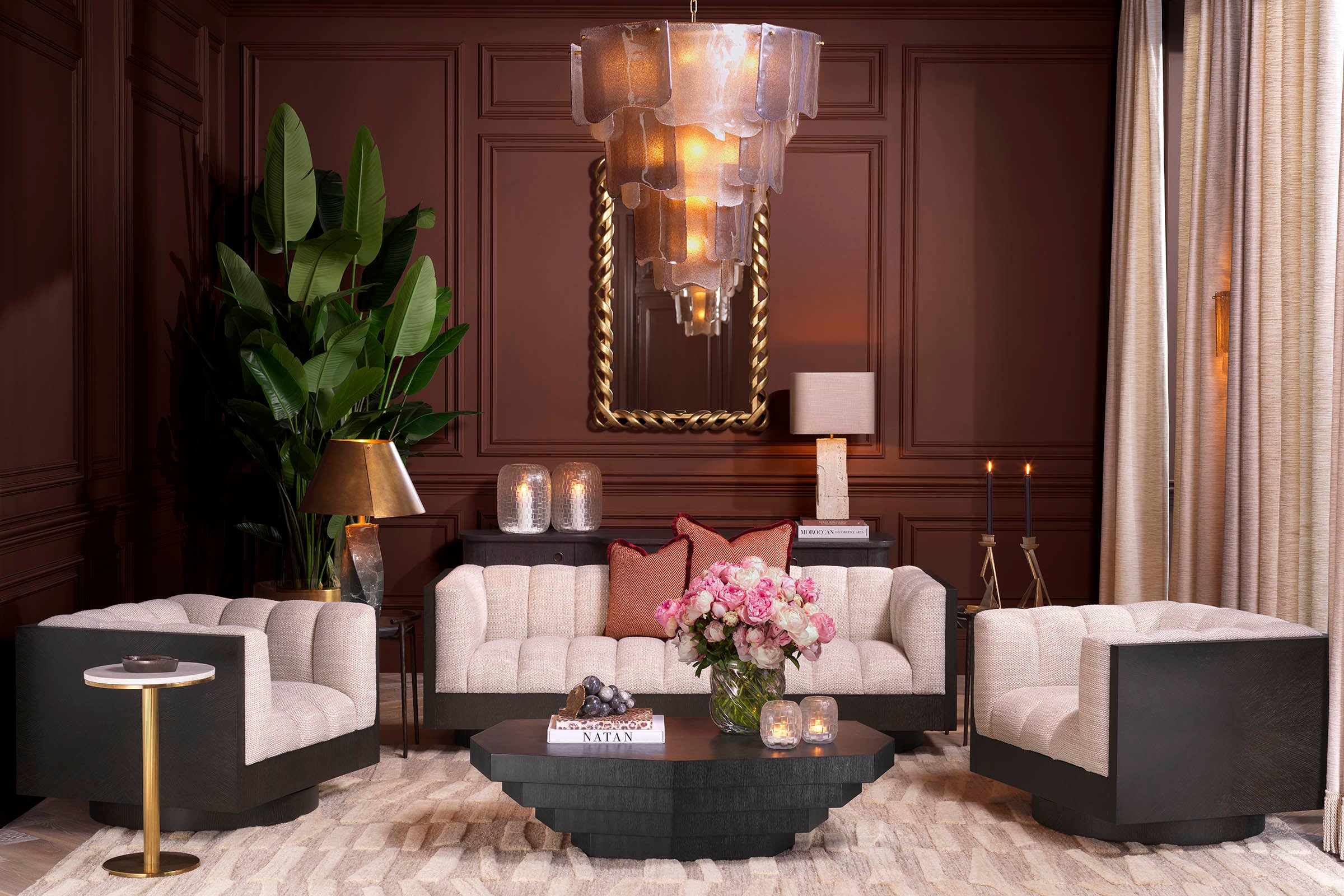
A single large mirror above a console does the work of an entire gallery wall — and eliminates the decision of what else to hang.
Placement: How High to Hang
When a mirror hangs above a piece of furniture, center it on the piece below rather than on the wall. The visual relationship is between the mirror and the console or dresser — not the mirror and the room. In practice, this means leaving four to six inches of space between the top of the furniture and the bottom of the mirror frame. Below that gap, the two pieces start to read as a single unit, which is the effect you want.
For a mirror hung on its own with no furniture below it, the center of the mirror should sit roughly at eye level — 57 to 60 inches from the floor in most residential spaces. In a hallway with very tall ceilings, push this slightly higher to keep the proportions from feeling compressed. In a room with lower ceilings, bring it down accordingly. The goal is a mirror that reflects the room, not one that shows only the ceiling above the viewer's head.
Floor mirrors and wall-mounted pieces that can be rotated follow different logic entirely. You position them to capture what you want to reflect — a window, a lamp, a portion of the room — and adjust the angle as the light changes. The Mirror Heracles, which mounts to the wall but can be oriented horizontally or vertically, offers a middle path: the flexibility of a leaner with the permanence of a wall-hung piece. Its handmade glass frame with antique brass accents holds up as a decorative object even when the room is still.
Layering: One Statement vs. a Gallery
A single large mirror and a cluster of smaller mirrors solve the same problem — an empty wall — through opposite approaches. The large mirror creates order and calm: one decision, one plane of reflection, one frame drawing the eye. A gallery of mirrors introduces movement and variety, and works well in spaces where you want the wall to feel collected rather than composed.
If you choose to layer mirrors, keep the spacing consistent — three to five inches between frames — and establish a center axis from which the arrangement grows outward. Vary the shapes rather than the sizes. Mixing a rectangular mirror with two rounds and an oval reads as deliberate. Mixing three different rectangles at mismatched heights tends to read as unfinished, no matter how good the individual pieces are.
There is also a third approach that sits between the two: a single large-format mirror in a sculptural or highly ornate frame, with nothing beside it. A frame with enough visual detail — handmade glass insets, a botanical motif, a bronze finish that shifts in different light — has enough interest to be the only object on a wide wall. No art beside it, no sconces flanking it. The frame carries the interest, and the mirror does the rest.

Care and Longevity
The reflective surface of an Eichholtz mirror cleans well with a soft microfiber cloth lightly dampened with water. Avoid ammonia-based glass cleaners on frames with bronze, antique brass, or handmade glass accents — the chemicals can dull or pit the finish over time. Dry immediately after cleaning; moisture sitting at the frame joint or behind the glass can, over time, cause backing discoloration at the edges.
For frames with a patinated or textured finish — the Duras wreath, for example — dust with a dry soft brush or cloth. These finishes are intentionally aged and do not need to be polished bright. If you want to restore some surface warmth, a brass-specific polish applied sparingly and buffed dry will do it without stripping the patina.
Eichholtz ships from a European warehouse network that carries a large number of pieces in stock. Lead times for available mirrors typically run two to four weeks. Our team at Eichholtz Las Vegas can advise on current availability for any piece — and help you determine which size, orientation, and finish reads best in your specific space, whether you are working room by room or on a larger project.
Explore the full mirror collection at Eichholtz Las Vegas, now open in Tivoli Village.
Shop Mirrors

