Skip to content


A desk is the most personal piece of furniture in a home. Where a sofa or a dining table is shared, a desk is usually yours alone — the one surface arranged exactly as you need it, at the exact height you prefer, facing the direction that helps you concentrate. The Eichholtz collection includes more than two dozen writing desks, bureau forms, and dressing tables. This is a guide to choosing the right one, and to placing it in a way that makes the room better, not just more functional.
The challenge most people face when buying a desk is that desks are sold as office furniture. The language is about storage, cable management, and ergonomics — all of which matter — but none of which explains how a piece reads in a living room at eight in the evening when you are not sitting at it. A desk that looks like office equipment does not disappear when work ends. It stays there, asserting itself. The Eichholtz approach treats the writing desk as furniture first and workspace second, which is the right order of priority for any piece that lives in a residential setting.
The desk you close your laptop on should look as good as the one you opened it on.
What to Ask Before You Commit
Three questions matter more than finish or leg style when choosing a writing desk for a residential space.
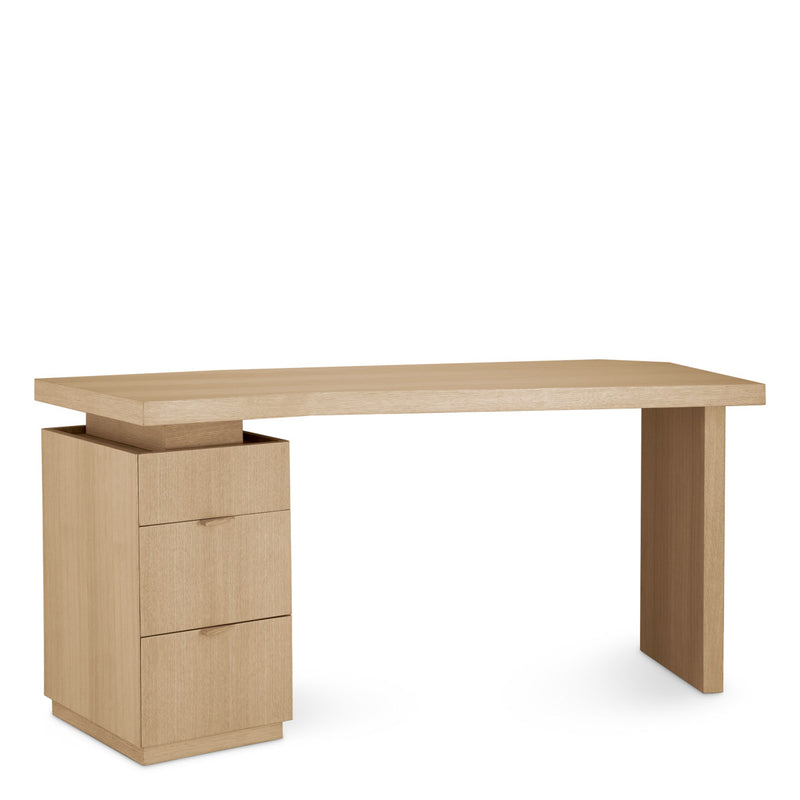
The first is drawers versus surface. A desk with drawers gives you storage, but commits you to a more substantial piece — one with a defined front and back, a fixed orientation, and a presence in the room that a simple writing table does not have. If you work regularly with physical materials — documents, samples, books, reference materials — drawers earn their space. If your work is on a screen and a notebook, a writing table without storage is often the better-looking and more versatile choice.
The second question is depth. Most desks are designed around a monitor footprint that has largely been replaced by laptops. A standard 70 to 80 cm depth is more than sufficient for most modern workspaces, and a shallower desk — one that sits closer to the wall it backs against — reads more refined and leaves more floor visible in the room. If you are placing a desk against a wall in a bedroom or sitting room, a slimmer profile makes the room look larger.
The third question is the view from across the room. A desk is a piece of furniture before it is a workspace, which means it needs to hold its own in the room when no one is sitting at it. What does the back look like? How does the piece read from the sofa, or from the doorway? Eichholtz desks are finished on all sides, which makes floating arrangements — a desk behind a sofa, angled into a room — viable in ways that most commercial office furniture is not.
- Drawers or surface? Choose drawers when you work regularly with physical materials. Choose a clean surface when you work on screens alone — the resulting piece is simpler, often more elegant, and easier to relocate.
- Depth. Standard desk depths are designed for monitors that most people no longer use. A desk at 70 cm or under reads better in most residential rooms and leaves more floor visible.
- The off-hours view. Look at the desk from across the room, not just from the chair. A piece that reads well from eight feet away is a piece you will still like in six months.
- Chair pairing. A writing chair that does not match the desk in material or finish is not a mistake — it is a design decision. Leather against a lacquered wood desk, cane against a brass frame — contrast often reads better than coordination.

Three Forms, Three Rooms
The Eichholtz desk collection reads across three distinct forms. Knowing which form fits your room makes the decision considerably easier.
The writing table is the most adaptable form — a flat working surface on four refined legs, with no storage and no architectural presence beyond the surface and the legs themselves. It reads as furniture in a living room, functions cleanly as a workspace, and settles into a bedroom corner without dominating the room. The writing table is the right choice when the desk is a secondary element in the space: when the primary reading of the room should be the seating, the lighting, or the view, and the desk is there to support function without redirecting attention toward itself.
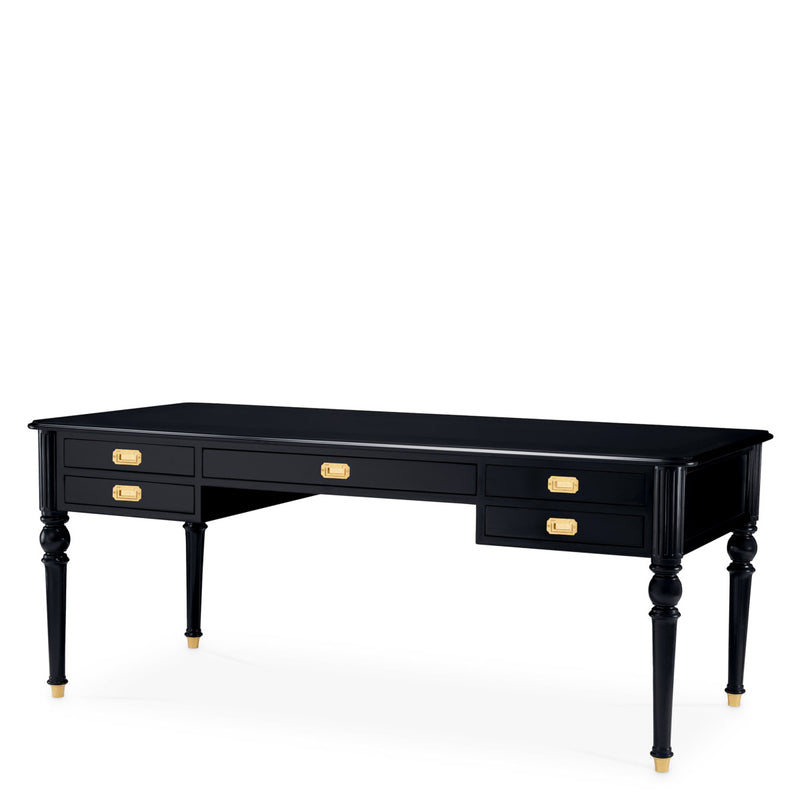
The bureau form is the desk as a statement piece. It has a defined body — usually with drawers, legs of some architectural character, and hardware that contributes to the room's material palette. It belongs against a wall in a room where the desk is meant to be noticed: a study, a well-appointed home office, or a bedroom arranged around the idea of a personal retreat. The Eichholtz interpretation of the bureau form tends toward restrained detail — brass hardware, clean joints, finishes in wood, lacquer, or a combination of the two — rather than the ornate historicism that this form can tip into in lesser interpretations.
The dressing table sits in the same product category as a desk in the Eichholtz collection, and for good reason: the proportions are nearly identical. A dressing table is typically narrower, often with a shallow ledge or mirror above, and designed to be used seated in a bedroom context. In practice, a dressing table serves as a personal workspace — a contained, quiet corner of a room dedicated to the individual — and the narrower, more personal footprint makes it the right answer for a bedroom desk that should not read as office furniture at all.


Lighting a Desk Correctly
A desk lamp is one of the few light sources in a room that sits at eye level rather than overhead. This makes it more present — and more scrutinized — than almost any other fixture in the space. The choice between a task lamp (directional, often articulated, designed to throw light at a specific point) and a decorative table lamp (designed to contribute to the ambient atmosphere of the room) is one most people do not make consciously, and should.
For a desk in a living room or bedroom — where the desk shares space with other furniture — a decorative table lamp usually reads better than a task lamp. The task lamp signals office. A considered table lamp signals room. If the desk is in a dedicated study or home office where function is the primary concern, a directional lamp is the correct tool. The distinction is worth making explicitly before you buy the lamp, because the two are not interchangeable in a residential context.
Lamp height matters more than most people consider. A lamp that sits too low creates glare at eye level when seated. The ideal position puts the base of the shade at approximately the seated eye line, so the light source itself is not visible from the working position. The Eichholtz table lamp collection spans from tall architectural floor pieces to compact desk-scale forms in brass, nickel, and ceramic — enough range to find the right proportion for any desk configuration.
Where the Desk Goes
A writing desk works in three positions in a residential room, and the position matters as much as the piece itself.
Against a wall, facing the wall — the most common arrangement and usually the most practical. The desk backs against an architectural element — a wall, a bookcase, a window — and the chair faces away from the rest of the room. This is the arrangement that reads as an embedded feature of the room rather than as a portable object placed in a space. A desk lamp on one corner and a small object or vase on the other are enough to make the setup read as a considered moment rather than a utilitarian corner.
In a corner, angled or square — a corner arrangement uses the geometry of the room to give the workspace a sense of enclosure. In a bedroom, a corner position keeps the desk from reading as the dominant element while still giving it an anchor. The corner approach often allows a slightly larger desk than a flat-wall arrangement, since the corner depth is otherwise unused space in most rooms.
As a floating piece, facing into the room — a desk placed behind a sofa, or in the center of a larger room, facing outward rather than toward a wall. This arrangement works when the desk's back is finished — which Eichholtz pieces typically are — and when the room is large enough that a desk in the center reads as one of several destinations rather than as the only focus. A desk behind a sofa in an open-plan living area defines the edges of the seating zone and gives the room a second purpose without requiring a separate study.
Pieces from the Eichholtz writing desk collection are available to see at the showroom at Tivoli Village, Suite 160, in Summerlin — opening this summer. Orders ship from the Eichholtz warehouse network, with most in-stock pieces available within two to four weeks, considerably faster than the twelve to twenty-four week lead times standard on made-to-order furniture.
Trade Access for Interior Designers
The Eichholtz Designer Trade Program gives you trade pricing across the full desk and furniture collection, plus direct project support from our team.
Apply for Trade Access