Skip to content


A drinks trolley is one of those pieces that earns its place immediately. It gives a room a focal point, a place to entertain, and an invitation to linger — all without taking up more than two square feet of floor. The trolley is also one of the few furniture pieces that reads as both practical and decorative from the moment it arrives in a room.
At Eichholtz Las Vegas, we carry more than twenty trolley styles — from open two-tier carts in brass and mirrored glass to enclosed multi-level serving pieces with cane panels and smoked-glass shelves. They work in living rooms, libraries, dining room corners, home offices, and primary suites. The question isn't where to put a trolley; it's which one suits the room it's going into.
A trolley is not just storage — it is a small stage for the things a room wants its guests to notice.
What a Drinks Trolley Does for a Room
A trolley performs three jobs that almost no other piece of furniture does simultaneously. First, it gives a dead corner a purpose. Corners next to sofas, beside a fireplace, or along a library wall are awkward to fill without over-furnishing — a trolley slots in with purpose and leaves the sightlines open. Second, it signals hospitality. A well-stocked, properly styled trolley tells guests that they are expected and that drinks are coming. Third, it is mobile. Unlike a bar cabinet, which anchors itself to a wall, a trolley can roll to wherever the evening actually happens — from the sitting room to the terrace to the dining table.
None of this requires the trolley to be elaborate. A simple two-tier brass piece with a mirrored top shelf does the work just as well as a fully fitted drinks cabinet. The trolley's power comes from its proportions — light enough to feel airy in a room, solid enough to feel intentional.
- Corner filler that doesn't block. A trolley's open silhouette fills vertical space without creating visual weight. It belongs in corners where a sofa or cabinet would over-furnish — giving them purpose without closing them off.
- Portable hospitality. Wheels mean the trolley moves with the occasion — from living room to terrace to dining room without lifting, planning, or rearranging furniture.
- Decoration on its own terms. A styled trolley — one with a few well-chosen bottles, a decanter, a small vase — works as a room object even when no one is drinking from it. It holds its own against a painting or a sculpture.

Brass, Chrome, and Black Glass: Choosing the Right Finish
The Eichholtz trolley range spans several distinct finish families. Brass — both polished and aged — is the most common frame material, and for good reason. It reads as warm in rooms with cream, ivory, and tan upholstery, and it contrasts well against dark walls, dark wood, and stone floors. Brushed brass sits between the two: less mirror-like than polished, less rustic than aged, and therefore the most versatile choice for rooms that are still being built out or that mix several finish families.
Chrome-frame trolleys bring a harder, cooler edge that suits rooms with marble surfaces, monochrome color palettes, or a decidedly modern sensibility. If the rest of the room's hardware leans silver — cabinet pulls, lamp bases, picture frames — chrome is often the more coherent choice than brass, even in a room that would otherwise read as warm.
For shelving, mirrored glass is the most forgiving — it reflects light and makes a trolley feel larger than it is. Black glass reads as more graphic and restrained. Clear glass is the lightest visually and the most practical for seeing what's on the lower shelf without bending. If in doubt, mirrored is the right answer almost every time; it flatters the objects on it and contributes light to the room rather than absorbing it.
Two Tiers or Three?
Most Eichholtz trolleys come in either a two-tier or three-tier configuration, with a small number offering enclosed compartments or cane-panel doors that sit closer to a portable bar cabinet than a traditional cart.
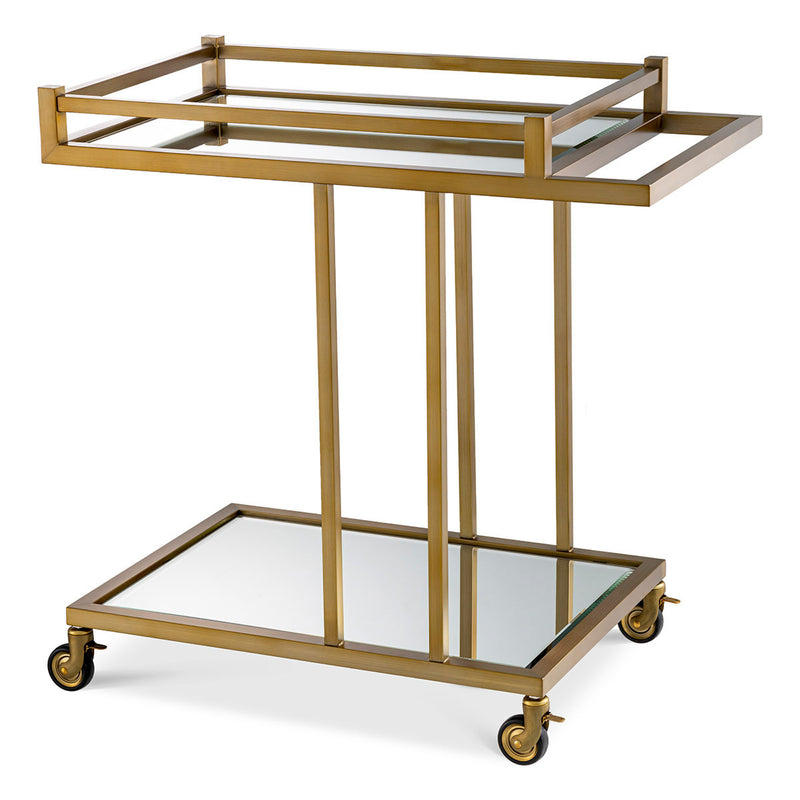
Two tiers work well when the trolley's primary function is hosting: the top holds bottles and glassware for immediate use; the bottom holds reserve bottles and one or two decorative objects — a stack of books, a small bowl, a sculpture — so the lower shelf contributes to the composition rather than functioning purely as overflow. The Trolley Beverly Hills is a clean example of this: two open tiers in brass and mirrored glass that style easily and leave space for arrangement without looking crowded.
Three-tier pieces extend the trolley's function. The additional shelf handles the things that would otherwise crowd the top — extra glasses, a decanter set, a champagne bucket. The Trolley Sterling takes this further, adding enclosed compartments with brass-mesh cane-effect doors, making it closer to a portable bar cabinet than a simple cart. It works in rooms where the trolley is the primary bar setup, not a supplement to one.
A rule of thumb: if the room already has a bar cabinet or a dedicated drinks area, two tiers is enough. If the trolley is the main bar in the house, three tiers or an enclosed option gives you the storage you need without requiring every bottle to live on the surface.


How to Style a Trolley
Styling is where a trolley becomes something more than a functional piece. The simplest rule: the top shelf is for what you are actively using; the lower shelf is for the composition. On the top, keep it practical — the bottles, the glassware, a decanter if the spirit warrants it, and a small tray to organize the items so they read as a collection rather than a cluster. On the lower shelf, balance the practical items with one or two decorative ones. A small vase, a low stack of design books, an object with weight and texture — a stone sculpture, a brass box, a ceramic bowl. Anything that has enough presence to hold its own against the bottles above it.
A common mistake is trying to stock the trolley completely — every bottle represented, every glass accounted for. A trolley looks better with a few well-chosen things than with everything it could possibly hold. Four bottles is a bar; eight bottles is a storage problem; three bottles, a crystal decanter, and two coupes is a statement.
Fresh flowers belong on a trolley when the room has a light palette. A full bunch of roses in a crystal vase — the kind of thing that reads as slightly theatrical in isolation — makes complete sense on a trolley in a sitting room with cream upholstery and brass hardware. If the room is darker and more restrained, lean into an arrangement of tonal objects instead: leather-bound books, a bronze figure, an aged brass tray with the barware organized inside it.
Where a Trolley Belongs
The obvious placement is beside the primary seating area — within reach of the sofa or lounge chairs, against a wall or in a corner that would otherwise be empty. But trolleys work in less obvious locations too. In a dining room, a trolley at the sideboard end of the room handles pre-dinner drinks and after-dinner spirits without requiring guests to get up and cross the room. In a primary suite, a small two-tier piece with a carafe of water, a champagne flute, and a few books functions as a considered alternative to a standard nightstand — for the evenings when the bedroom is meant to feel like an occasion.
The key placement consideration is access from at least two sides. A trolley pushed flush to a wall in a narrow corridor becomes a storage unit — visible but not workable. It should sit with enough clearance on three sides to allow someone to pour comfortably, and the wheels should be unlocked when the trolley is in use so it can be brought into the conversation rather than approached across the room.
In-stock Eichholtz trolleys ship from our warehouse network in two to four weeks — a lead time that makes them one of the quicker pieces a designer can specify while the rest of a project's upholstery and case goods are in production. Visit us at Tivoli Village, Suite 160, to see the full range in person and get a feel for the scale before you commit.
Trade Pricing on the Full Collection
Designers and trade professionals can access the entire Eichholtz catalog at trade pricing through our Designer Trade Program.
Apply for Trade Access