Skip to content


A side table holds a lamp, keeps a drink at arm's reach, and anchors the space beside a sofa or chair. That sounds like a functional role — and it is — but the side table also does something harder to quantify: it tells you whether a room is finished.
At Eichholtz Las Vegas, we carry the full Eichholtz side table range, which spans everything from sculptural brass-and-glass constructions to pieces from The Met × Eichholtz collection, where museum-quality design meets living-room utility. The collection is wide, and the decisions are real. This guide walks through how to think about them.
The side table is the last thing a room needs and the first thing a room misses when it's gone.
What a side table is actually doing
Start with the job. A side table sits beside seating — a sofa, a lounge chair, a reading chair — and serves as a landing pad and a visual anchor. Without it, the sofa floats. With it, the seating group becomes a composition. This is why a missing side table is so noticeable even when you can't immediately name what's wrong with a room.
There are three things a side table handles simultaneously:
- Surface utility. A lamp base, a book, a glass of water, a phone — a side table earns its keep daily. Height matters: aim for a tabletop that aligns roughly with the sofa arm, within a few inches either way, so reaching feels natural.
- Visual balance. A tall sofa with nothing beside it reads as heavy on one side. A side table — even a relatively small one — draws the eye out and creates a horizontal rhythm across the seating group.
- Material conversation. The side table introduces a second material into the vignette. If your sofa is upholstered in a neutral fabric, the side table is where brass, marble, glass, or stone enters the palette. That is a design decision, not a styling afterthought.
How to choose the right one
Height and scale are the non-negotiables. The tabletop should sit at or slightly below sofa-arm height — typically between 22 and 26 inches for standard sofas, and lower for low-profile pieces. Go too high and reaching down to the table feels awkward; go too low and the table reads as a coffee table that got lost.
Scale is relative to the seating. A deep, substantial sectional can carry a more architectural side table. A narrow reading chair works best with something lighter — a single-column pedestal or a compact round form. The side table should read as a companion to the seat, not compete with it.
On pairs versus singles: pairing two identical or complementary side tables on either end of a sofa creates symmetry and a sense of intention. A set of two nesting tables gives you flexibility — pull one out when you need it, tuck it back when you do not.

The material question
The side table is where material decisions become specific. Brass is warm, versatile, and ages with character — a vintage brass finish is softer and less reflective than polished brass, which makes it easier to work into a room with varied lighting. Glass tops brighten a tight corner because they do not add visual mass; light passes through and the table seems to float. Marble is heavier visually and physically, but a white marble top brings a grounding natural element that pairs well with dark-legged furniture or rich upholstery.
Wood is a different conversation. Open-grain veneer — the kind that reveals the true movement of the grain — connects a side table to the furniture tradition Eichholtz comes from: craft, not just decoration. A wood veneer structure with a contrasting top material — antiqued mirror glass, for instance — bridges old and new in a single piece.
Three side tables from the Eichholtz collection
These three pieces represent three distinct points in the Eichholtz side table range — different materials, different scales, different design stories.


The Side Table Metropolitan is part of The Met × Eichholtz collection. Its design draws on the geometric language of The Metropolitan Museum of Art's front steps — open-grain veneer on the base structure, with an antiqued mirror glass top that reflects the room rather than simply sitting in it. It is a piece with a specific design reference, which gives it a different presence in a room than furniture designed purely to solve a function.
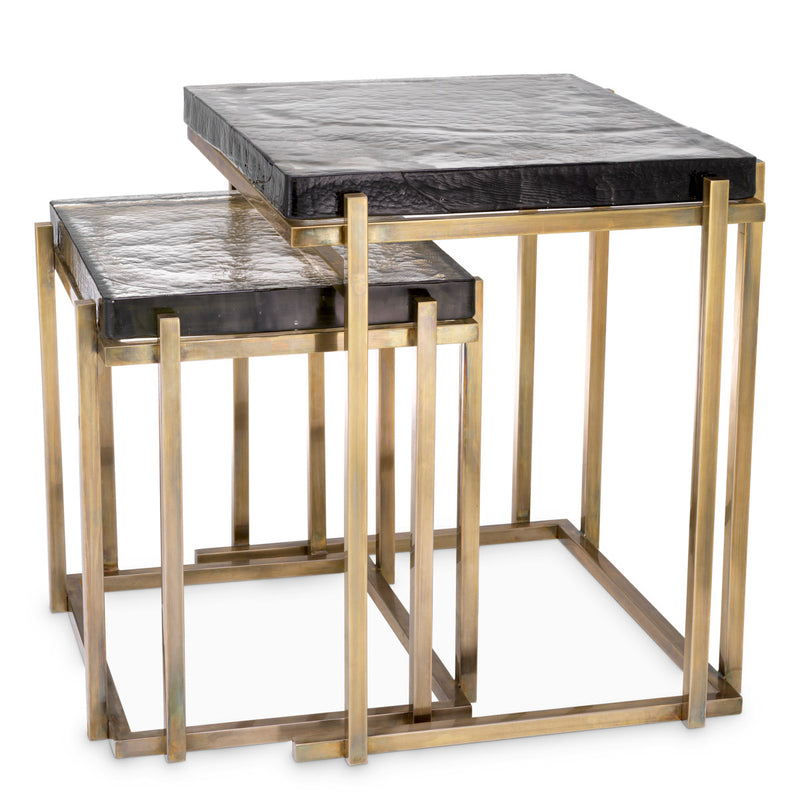
The Side Table Niemeyer Set Of 2 is named for the Brazilian architect whose work gave organic curves their rightful place in modernism. The pair features a vintage brass frame and thick, individually handcrafted glass tabletops — no two pieces are identical. The craftsmanship is intentional: each glass top is made by hand, so each table carries slight variations in the glass itself. For a matched set, that variation works in your favor; it gives two frames a sense of life that mass production cannot replicate.
The Side Table Pigna takes its name from the Italian word for pine cone, and the reference is direct: the branching brass legs are cast in the form of a cone's outer scales, finished in vintage brass. A round white marble top completes the structure — smooth stone against textured metalwork. It is the kind of piece that rewards a closer look; the form reads very differently from across the room than it does from two feet away.
Where side tables work hardest
The obvious placement is beside a sofa. But side tables also do meaningful work beside a lounge chair in a corner, between two club chairs in a sitting area, or as a pair flanking a bed. In an entry hall, a small round side table — without the constraints of a full console — can give a tight space what it needs without overwhelming it.
When we set up seating groups at the showroom, side tables are among the last elements placed. They also change the most. The sofa composition reads as a distinct zone once the tables are in. The lamp has a base. The vignette has structure. A room that was technically complete becomes actually comfortable. It is a small thing, and it matters.
We carry over one hundred eighty Eichholtz side tables at Eichholtz Las Vegas, spanning materials from brass to marble to glass to open-grain veneer, in scales from compact accent pieces to substantial architectural forms. In-stock pieces ship directly from the Eichholtz warehouse network in two to four weeks — considerably faster than the twelve to twenty-four weeks standard on made-to-order luxury furniture. Our team is available to help narrow a selection for a specific room. Bring your dimensions.
Work with our team
Interior designers and trade professionals can access the full Eichholtz catalog at trade pricing through our Designer Trade Program. If you specify for client projects — residential, hospitality, or commercial — the program is built around that workflow. Apply online or in the showroom. We are opening at Tivoli Village, Suite 160 in Summerlin, Las Vegas, in summer of 2026.
Apply for Trade Access
Trade pricing on the full Eichholtz catalog for qualifying designers and professionals.
Apply for Trade Access