Skip to content


An ottoman is the most adaptable piece in a furnished room. It handles three jobs — footrest, surface for a tray and drinks, extra seat — and does all of them without calling attention to itself. When it is the right shape and scale for the space, it reads as part of the room's architecture. When it is the wrong size or placed incorrectly, you notice every day.
At Eichholtz Las Vegas, the ottoman collection spans compact upholstered squares designed to pair with a single armchair, to generous rounds scaled to anchor a large seating group. Each piece is specified with seat height and depth in mind, which is why the spec sheet matters as much as the photograph. The right ottoman is a decision made with dimensions on the table, not just an instinct for fabric.
A well-sized ottoman reads as part of the room. An undersized one reads as something that got left there.
The Three Jobs an Ottoman Does
Most people think of an ottoman as a footrest, and that is its most obvious job. A deep sofa without an ottoman asks you to plant your feet on the floor or tuck them under the cushion — neither is comfortable for long. An ottoman at matched seat height completes the ergonomics of the sofa, lets you sit back fully, and changes how the piece reads in the room from every angle.
The second job is as a coffee table. This requires a tray — a flat, firm surface in lacquer, stone, or leather that gives you a stable place to rest a drink without it tilting. Without the tray, guests hesitate to use the top, and the piece ends up looking underused. With it, the ottoman becomes the functional center of the seating group. Several pieces in the Eichholtz collection are upholstered in performance fabrics precisely because the top surface will see daily use as a work surface or a place to set a book.
The third job is the one most people discover after the fact: overflow seating. A well-placed round ottoman in the center of a seating group becomes a natural extra seat when the sofa and chairs fill up. Round forms in particular are easy to pivot into position — no corners to negotiate, no hard edge to navigate past. If the piece needs to travel between the center of the room and a wall depending on the occasion, round is more practical to live with day-to-day.
Round vs. Square: How Shape Affects the Room
Shape is the first decision, and it follows from the sofa and the room layout more than from personal preference.
Round ottomans carry no hard corners, which makes them a natural complement to curved sofas and to rooms arranged in a loose arc rather than on strict perpendicular lines. They also move easily — a round ottoman slides around the seating group without disrupting sight lines. If the room's layout shifts depending on the occasion, round is more forgiving.
Square and rectangular ottomans read as more architectural. They pair naturally with sofas that have defined, squared-off arms and with rooms where the furniture follows a grid. They also work better as coffee-table substitutes — the straight, parallel edge aligns with the sofa front in a way a round form cannot, and that alignment is what makes a seating arrangement look intentional from across the room.
- Deep sectional. Choose a generous round or oval. Sectionals generate significant seat depth; a small square gets visually lost against them. A round at thirty-six inches in diameter or larger gives the arrangement the anchor it needs.
- Three-seat sofa. A rectangular ottoman at roughly two-thirds the sofa length is the standard solution. It aligns with the sofa's front edge and sits flush within the coffee-table zone.
- Facing sofa pair. Two smaller rounds flanking a low central tray read better than one large rectangle, which can block sight lines across the seating group and make the zone feel closed off.
- Single armchair. A compact square or small round is sufficient. One chair, one footstool, one corner resolved without overthinking it.

Getting the Scale Right
Scale is where most ottoman decisions go wrong. The piece looks proportionate on a product page and then sits in the room feeling too small — or occasionally too large, with the sofa's occupants unable to reach it comfortably without sliding forward in the seat.
The starting rule: the ottoman should be approximately two-thirds the length of the sofa it faces. For a ninety-inch sofa, that puts you at around sixty inches for a rectangular piece, or roughly twenty-four to thirty-six inches in diameter for a round, depending on seat depth. These are starting points — some rooms require a slightly more compact piece to preserve traffic flow through the seating group.
Distance from the sofa matters equally. The front edge of the ottoman should sit between eight and eighteen inches from the front edge of the sofa cushion. Closer than eight inches and it becomes a hazard when someone stands. Further than eighteen inches and it loses its functional connection to the sofa — it stops reading as a footrest and starts reading as a low coffee table that belongs to no one.
Height is the third measurement to confirm before ordering. An ottoman that sits one to two inches below the sofa seat height is ideal. Your legs rest naturally, and the piece recedes slightly under the sofa frame rather than sitting above it. An ottoman that rises higher than the seat height is immediately noticeable and uncomfortable. Most Eichholtz specifications include both the seat height and overall height in the data sheet — measure your existing sofa before placing an order.
The Collection at Eichholtz Las Vegas
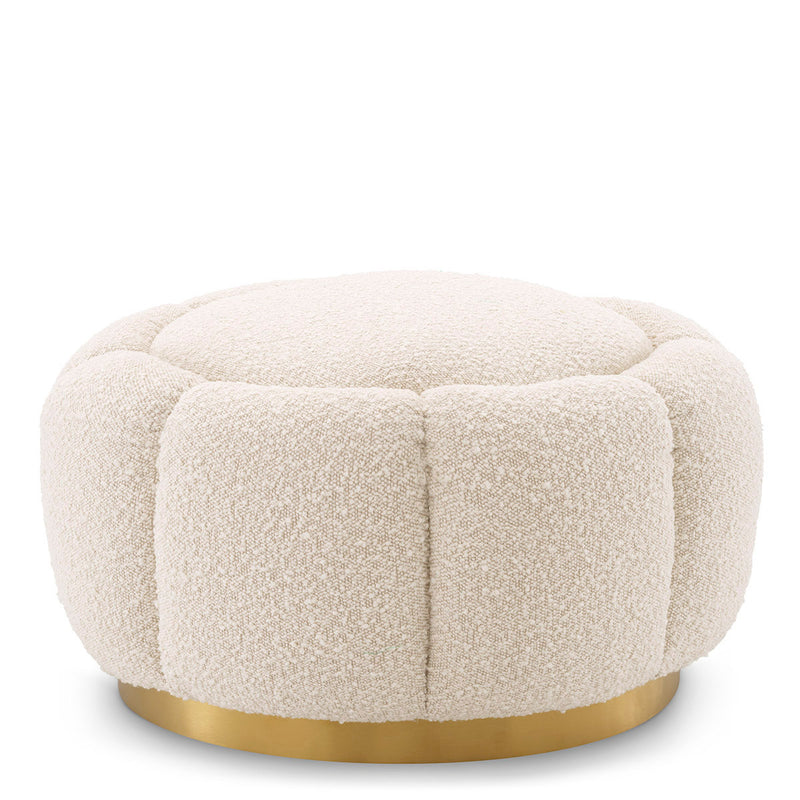
The Eichholtz ottoman selection covers the full range of form and upholstery. The Inger is a compact, tightly upholstered round available in velvet and boucle — it works beside a single armchair, as a low accent piece in a primary bedroom corner, or paired with a compact two-seat sofa in a smaller sitting room. It earns its keep without taking up much floor space.
The Vista Grande is the opposite end of the range: a generous round with the scale to hold the center of a large seating group. Where the Inger is discreet, the Vista Grande makes its presence felt through proportion. It is the piece for a room with a sectional, or for two facing sofas where the center of the arrangement needs a visual anchor that reads from across the room.
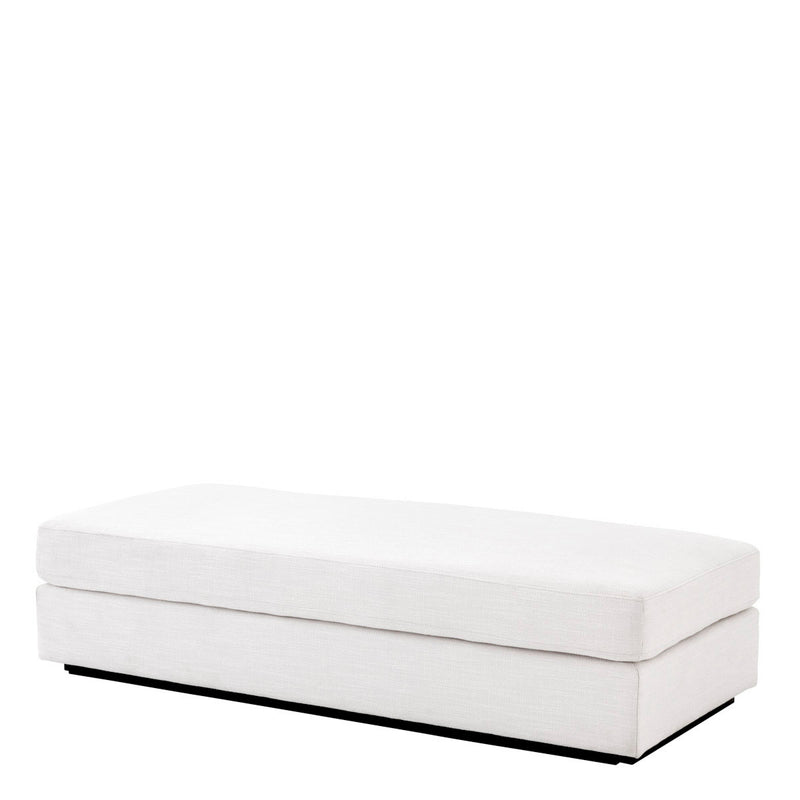
The Dorantes is a rectangular ottoman with close-nailed leather trim along the perimeter, upholstered in a palette that leans toward the tailored end of the Eichholtz range. The top surface is firm enough to serve as a coffee table with a tray. Its proportions align cleanly with a standard three-seat sofa, and the leather perimeter detail reads well in rooms where the other upholstery is fabric — it creates visual contrast without requiring additional decorative objects to carry the difference.
All three ship from the Eichholtz warehouse network. In-stock pieces typically deliver in two to four weeks — significantly faster than the twelve to twenty-four weeks that is standard on made-to-order luxury furniture at this level. If you are working toward a move-in date on a project, that delivery window is worth factoring into the specification.


Before You Finalize
If you are working through a larger room composition — sofa, accent chairs, and ottoman together — it is worth coming into the showroom before finalizing the ottoman selection. Pieces look different next to each other than they do on separate product pages. Seat heights vary slightly by sofa model, and the visual weight of an upholstered form reads differently against a curved sofa than a straight-armed one.
Bring your floor plan and the dimensions of your sofa if it is not from the Eichholtz collection. We can pull ottoman pieces alongside comparable sofa options and work through height, depth, and fabric direction before anything goes on order. That is the point of a showroom — you should not have to guess on something this specific.
Eichholtz Las Vegas is open at Tivoli Village, Suite 160, in Summerlin. The showroom carries a selection of pieces from the full Eichholtz catalog, with the range represented across seating, lighting, tables, and accessories.
Work With Our Showroom Team
Interior designers receive trade pricing on the full Eichholtz collection — apply before your next project.
Apply for Trade Access