Skip to content


Mixing metal finishes in a room is one of the most common questions interior designers hear — and one of the most common things homeowners get wrong when they try to do it on their own. The short answer: it works, and it works far better than committing to a single finish throughout. A room built entirely on brass reads flat. A room with nothing but chrome reads cold. The rooms that feel genuinely composed carry at least two metal families, and often three.
The Eichholtz collection spans every major metal register — antiqued and brushed brass, cool-toned nickel, dark bronze, blackened steel, smoke glass with metal trim, and more. When we built the showroom at Tivoli Village, we merchandised the floor in complete vignettes specifically so that visitors could see these combinations at full scale, in three dimensions, rather than reading about them in the abstract. This guide covers the logic behind the combinations: which metals belong together, which don't, and how to build the proportions that make a mixed-metal room feel deliberate rather than accidental.
A room with only one metal finish tends to feel like a sample board — not a home.
The Three Metal Families
Every metal finish in the decorating vocabulary belongs to one of three families. Understanding the family is more useful than memorizing specific finishes, because the rule operates at the level of tone — warm, cool, or dark — not at the level of exact material.
- Warm metals. Brass, gold, bronze, and their antiqued or brushed variants. They sit naturally next to wood tones, stone, cream and ivory upholstery, and anything in the caramel-to-cognac range. Warm metals carry the most visual warmth of the three families and typically serve as the dominant finish in a room.
- Cool metals. Nickel, chrome, silver, and polished platinum. These read as modern, graphic, and precise. They pair naturally with marble, glass, pale grey or white upholstery, and anything with a clean geometric edge. Cool metals introduce crispness without darkness — they sharpen a room rather than grounding it.
- Dark metals. Blackened steel, dark bronze, graphite, aged iron, and oxidized finishes in the deeper range. Dark metals do the heaviest work: they give a room visual weight, stop a space from floating away into softness, and add a note of authority that warm and cool metals alone cannot deliver.
Most well-designed rooms draw from at least two of these families. Brass and blackened steel is a classic pairing — warm and dark together, with nothing cool to distract. Nickel and brass is equally standard: a cool-warm contrast that feels fresh without being cold. A room working all three families simultaneously — handled in the right proportions — becomes a full palette, with layers the eye can explore rather than read in a single pass.
The 60/30/10 Rule in Practice
Interior designers use a rough proportional rule when mixing metals: one dominant finish at roughly 60 percent of the room's metallic presence, a secondary finish at 30 percent, and an accent finish at 10. The numbers are not precise; they describe a hierarchy. One metal should be clearly in charge, a second should confirm the system, and a third should add depth without competing for the same attention.
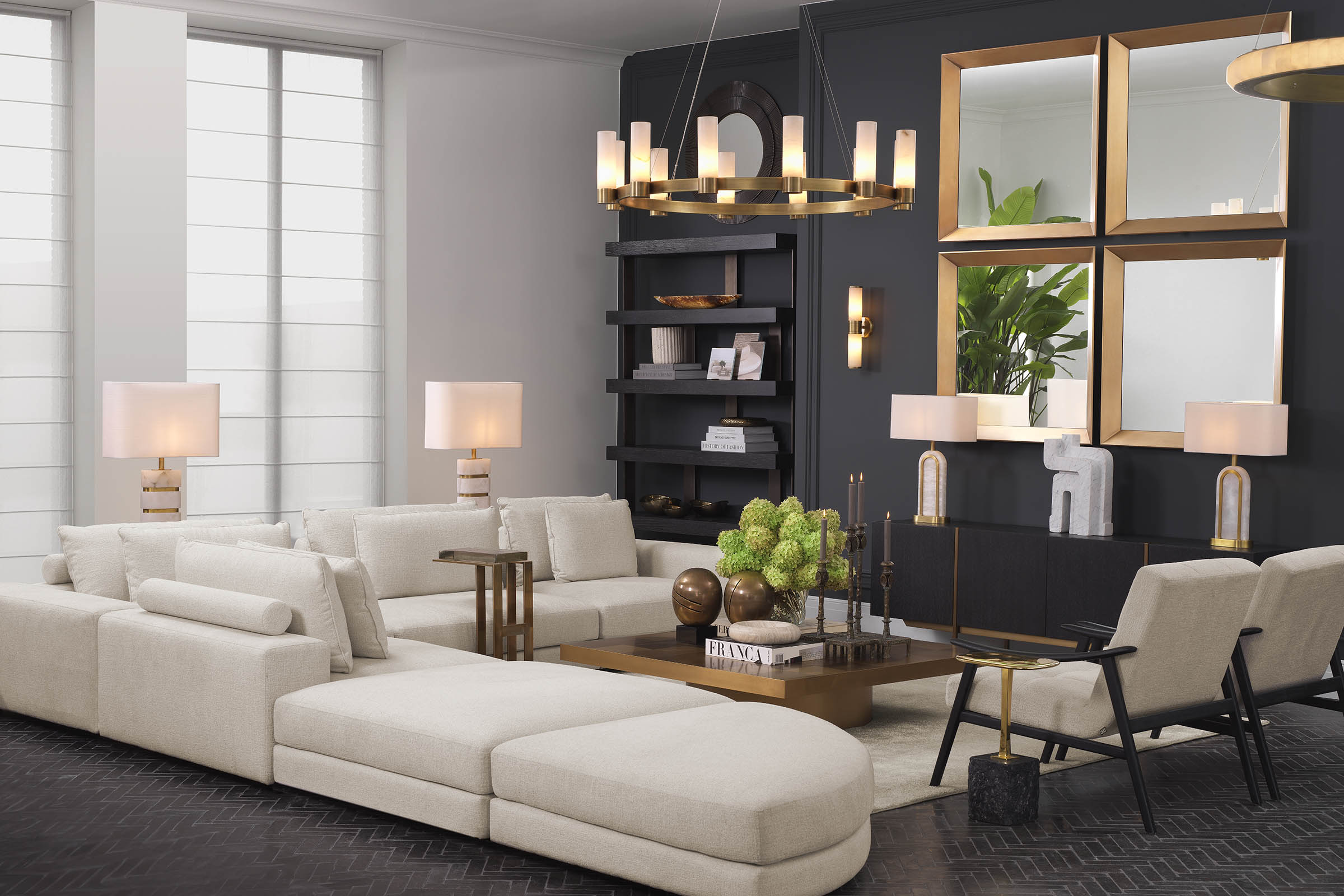
Your dominant metal typically shows up in the room's largest fixture — the chandelier or pendant, the primary light source that anchors the ceiling plane. If that piece is in antiqued brass, brass is your lead finish. Everything else either supports or contrasts it. Your secondary metal shows up at the mid-scale level: sconces, a table lamp base, a side table frame, a mirror surround, cabinet hardware. It appears often enough that the eye registers it as intentional, but not so often that it challenges the lead. Your accent metal appears once or twice at small scale — a tray, a candleholder, a vase collar — and earns its place precisely by being used sparingly.
The practical implication: when you walk into a furniture showroom to build a mixed-metal room, start with the largest fixture first. Choose that piece based on which metal family you want to lead. Then build outward from it, deliberately selecting secondary and accent pieces from the other families. This sequences the decisions in the right order, rather than selecting pieces individually and hoping they work together after the fact.
Brass, Nickel, and Bronze: Three Pieces, Three Registers
Three pieces from the current Eichholtz collection illustrate each metal family and show how the system works in practice.
The Chandelier Melrose makes the case for warm-metal dominance. Constructed from antiqued brass with light smoke glass shades, it carries both a metal and a material dialogue in a single piece — the brass warm and slightly darkened by the antiquing treatment, the smoke glass introducing a cooler, more graphic note at the shade level. The Melrose has enough visual mass to anchor the ceiling in a dining room or a generous living space. When brass is your dominant metal, this is the kind of piece that earns the lead role — not simply because it is made of brass, but because its form gives the finish the scale it needs to be read across a room.
For the cool-metal register, the Mirror Kravis makes the case for nickel at eye level. The frame carries a nickel finish — cool, slightly reflective, clean-edged — against beveled mirror glass. In a room where the chandelier and side tables are brass, the Kravis introduces a contrasting metal that the eye reads as a system: warm overhead, cool on the wall, complementary rather than competing. Mirrors serve a double function in mixed-metal rooms: the frame contributes its own finish to the room's metallic palette, while the glass reflects and multiplies the light and warmth already in the space. A nickel mirror near a brass chandelier softens the warm-heavy register of the ceiling without adding another warm fixture.
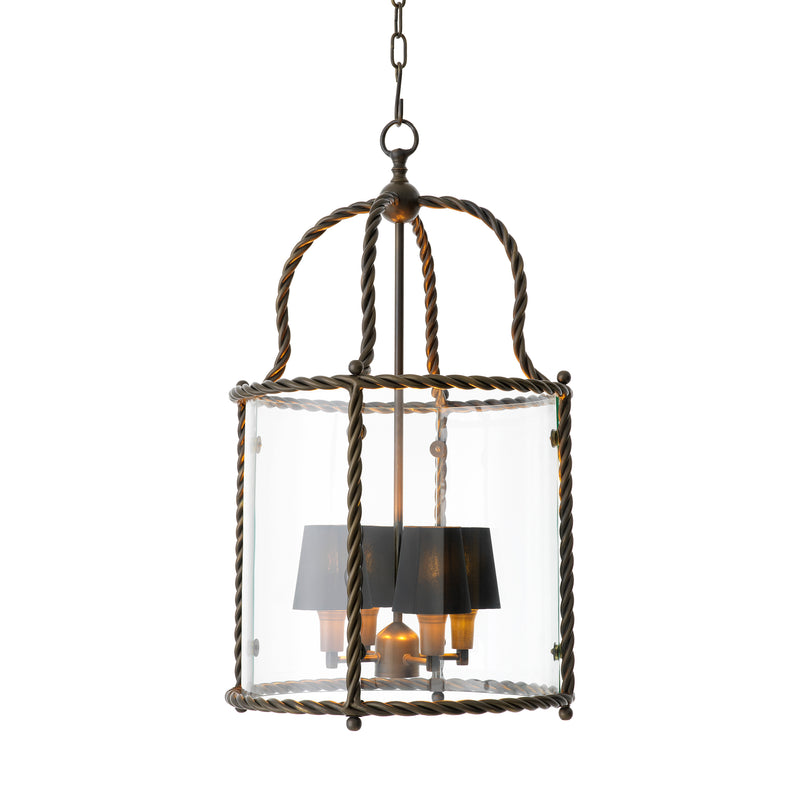
The Pendant Preston in bronze highlight finish covers the dark register. It is a handmade lantern-style pendant: a twisted brass frame wrapping clear glass, with a cluster of black shades. The piece contains two finishes in deliberate contrast — the brass frame warm and structural, the black shades dark and graphic. As an accent piece in a room already carrying brass and nickel, the Preston introduces the third metal family at a scale that holds weight without overwhelming. It works particularly well as a cluster pendant over a reading corner, a bar area, or a lower-height space where its lantern quality reads at close range.


What Does Not Work
A few patterns reliably undermine a mixed-metal room, and most come from applying the right concept without the right proportions.
The first is using the same warm metal everywhere — brass chandelier, brass sconces, brass cabinet hardware, brass vase, brass tray. Repeated identical finishes read as a hotel lobby: coherent but not personal, assembled rather than designed. Warm metals need contrast to breathe. Without it, they become visual background noise rather than a deliberate choice.
The second is splitting all three families equally. When warm, cool, and dark finishes each occupy roughly the same visual weight in a room, no finish reads as primary and the room feels indecisive. The hierarchy in the 60/30/10 rule is not decorative; it is what makes the room legible. Three metals of equal weight cancel each other out.
The third is using dark metals too heavily in a confined space. Blackened steel and dark bronze are most effective as punctuation — used precisely and sparingly. A small room with two large dark-metal fixtures and no warm counterbalance produces heaviness, not drama. The contrast that makes dark metals interesting disappears when they dominate.
The fourth is choosing finishes that share the same tone but not the same treatment level. Brushed brass and polished gold are both technically warm metals, but their surface characters are different enough that they read as a mismatch rather than a system. Finishes need to be compatible in their treatment: antiqued brass pairs naturally with aged bronze; polished gold reads differently and benefits from a transitional piece to bridge the distance.
Seeing the Combinations at Scale
When the Eichholtz Las Vegas showroom opens this summer of 2026 at Tivoli Village, one of the most useful things you can do is stand inside a fully installed vignette and read the metal registers. The collection is merchandised as complete rooms — not individual pieces in isolation. You can see firsthand how antiqued brass reads next to a nickel detail, how a dark bronze piece grounds a cream upholstered grouping, how a room built on three metal families sits at rest rather than at competition.
We welcome interior designers and homeowners. For designers working with trade clients, the showroom is a working tool — a space to bring clients, walk them through finish combinations at full scale, and make decisions with real pieces in hand rather than sample chips on a moodboard. For in-stock Eichholtz pieces, delivery typically runs two to four weeks from the warehouse — a meaningful advantage over the twelve to twenty-four weeks standard on most made-to-order luxury furniture.
Browse the full lighting and accent collection on the site, or apply for trade access below if you are specifying on behalf of clients.
Apply for Trade Access
Interior designers can apply for trade pricing on the full Eichholtz catalog.
Apply for Trade Access