Skip to content


A floor lamp does something no chandelier or recessed fixture can: it puts light at standing height, near the furniture, at the scale of the person using the room. That distinction sounds simple, but it changes how a space feels at night more than almost any other single decision in a room.
At Eichholtz Las Vegas, we carry more than two dozen floor lamps across finishes and silhouettes — from spare and contemporary to architectural and sculptural. What follows is a guide to how they work, where to place them, and what separates a floor lamp that earns its spot from one that merely fills a corner.
A floor lamp doesn’t just add light. It adds a vertical presence the room’s eye naturally finds.
Why Floor Lamps Work Differently
Overhead lighting — chandeliers, pendants, recessed fixtures — illuminates from above. It fills the space and sets the room’s overall light level. A floor lamp works from a different height, closer to the furniture and the people using it, which means the light it casts feels warmer and lands where it’s actually useful. It doesn’t compete with the chandelier above it; it creates a separate lighting layer below.
A floor lamp also contributes to a room’s visual composition in a way that overhead fixtures can’t. Placed beside a sofa or behind a reading chair, it creates a vertical element that anchors a corner and balances the horizontal weight of upholstered seating. In rooms where everything sits low — low sofa, low coffee table, low rug — a standing lamp often pulls the eye upward without requiring anything to be mounted, drilled, or wired into the wall.
- Ambient fill. A floor lamp with a diffuse or upward-facing shade broadcasts light softly across the ceiling and walls, eliminating the shadow pockets that recessed lighting can create in corners and alcoves.
- Task focus. A directional or adjustable shade puts concentrated light exactly where it’s needed — a reading chair, a writing surface, a sofa corner used after dark.
- Sculptural presence. Some floor lamps hold the eye because of their material, their form, or their finish — before the light is ever switched on. The base, the stem, and the shade work together as a composition.
- Flexible placement. A floor lamp can be repositioned when furniture moves. Adding a sconce or repositioning a recessed fixture requires an electrician.

Three Archetypes Worth Understanding
Most floor lamps fall into one of three types. Knowing which one you’re solving for before you choose makes the selection considerably simpler.
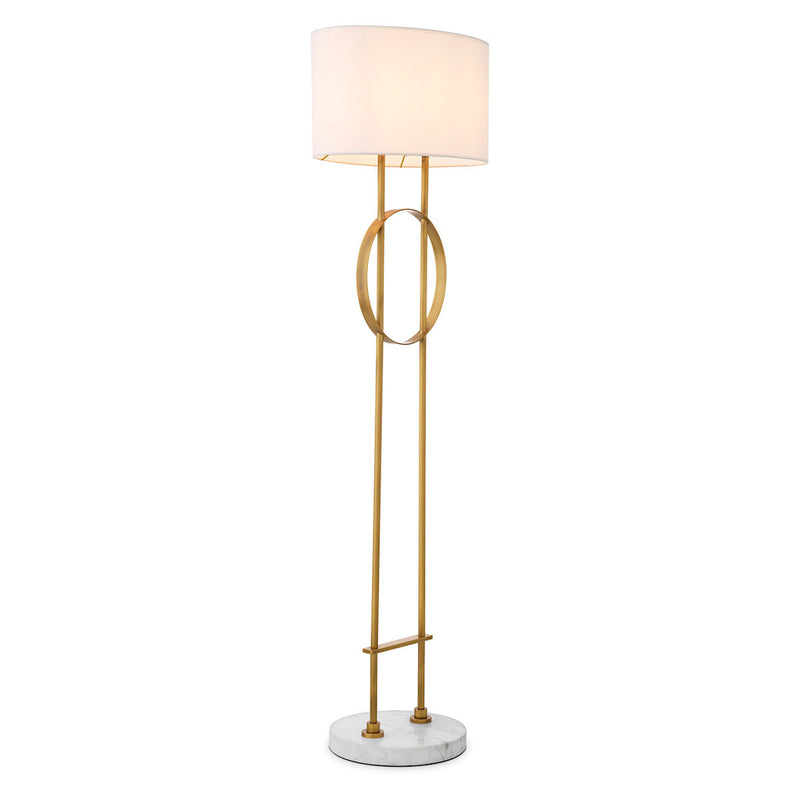
The architectural floor lamp is defined by its structure. The frame — often metal, often brass — is the point of the piece, and the shade is secondary. Floor Lamp Kaiser belongs here. Its antique brass frame carries clean vertical lines intersected by geometric elements, giving it the kind of presence that reads clearly across a tall-ceilinged room. These lamps do their work before you switch them on. You notice the composition first; the light is the bonus. They suit formal living rooms, double-height spaces, and any interior where the lamp is meant to be a visual anchor as much as a light source.
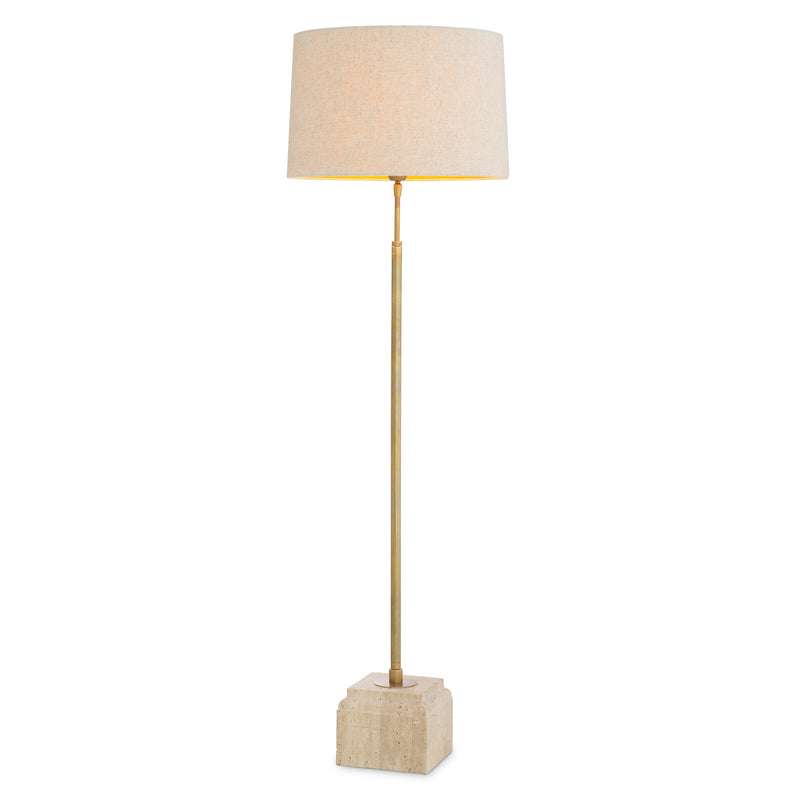
The material-contrast lamp is built around a conversation between two or more materials. Floor Lamp Rialta pairs a solid travertine base — dense, cool-toned, tactile — with a vintage brass stem and a viscose-linen shade. The three materials don’t match; they counterpoint. That tension is the point. This type of lamp works particularly well in rooms that already layer materials: a marble or stone coffee table, an upholstered sofa, a wood-and-brass console. The Rialta borrows from the room’s existing palette and adds one layer more without repeating anything already there.
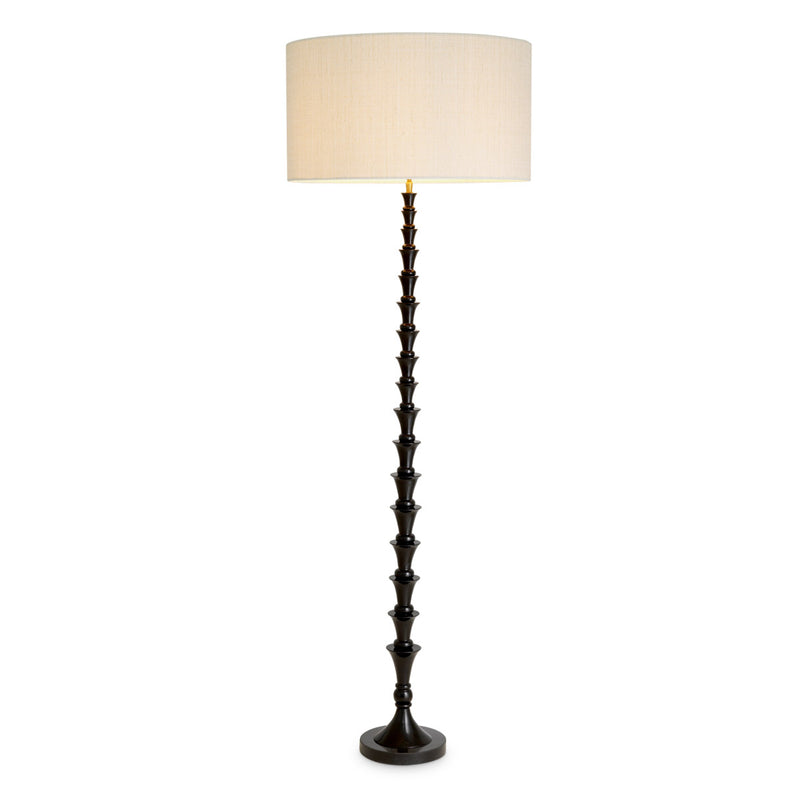
The refined minimal lamp prioritizes proportion and finish over complexity. Floor Lamp Arabella does exactly this: a slim wooden frame in piano black, a black granite base, a linen shade in a neutral that recedes against most walls. Nothing competes. Nothing calls attention to itself. These pieces work well in rooms where the furniture is already doing a great deal — a statement sofa, a bold rug, a large piece of art on the wall — and the lighting is meant to support the composition rather than add to it.


Where to Place a Floor Lamp
Most living rooms benefit from two floor lamps placed symmetrically on either side of a sofa. This mirrors the sofa’s horizontal span and gives the seating area a sense of completion. If the sofa sits off-center, one lamp at the far end — positioned slightly back, angled toward the seat — often works better than two. It draws the composition outward without overwhelming a smaller room.
Reading chairs have a specific geometry. Place the floor lamp just behind and slightly to one side of the chair — not directly behind it, which throws shadow onto whatever you’re reading, and not at face level, which creates glare. Slightly back, slightly to the side, directed downward. Most people have to try this position before they believe it, but it’s consistently the one that feels right.
Corners that collect visual weight — the dead space behind a chair or beside a large plant — are solved by a tall floor lamp. The lamp earns the corner, and the piece of furniture placed nearby gains a reason to be there rather than appearing stranded.
In bedrooms, floor lamps are more useful than most people anticipate during initial planning. In a room without bedside sconces, a tall floor lamp beside the bed replaces both a table lamp and the need for a side table, freeing up the surface. In a primary bedroom with a seating area, a floor lamp completes the reading chair the same way it does in a living room: it turns a corner into a proper room within a room.
How to Read a Shade
The shade is at least as important as the base, and it’s the part most people spend the least time thinking about. An ivory or cream shade with a reflective white inner lining sends light outward and upward, filling the room. A dark outer shade with a warm inner lining directs light downward and concentrates it into a pool. Linen and natural fabric shades diffuse light evenly. An opaque drum shade focuses it tightly.
All of this is invisible until the lamp is on — which is one reason we encourage people to see our floor lamps lit in the showroom before deciding. Eichholtz designs the relationship between base and shade as part of the piece, not as a separate choice. The Rialta’s travertine base pairs with a viscose-linen shade because both share the same warm, organic register. The Kaiser’s antique brass frame pairs with a cream shade that lets the brass read clearly without competition from a darker or patterned textile. These are deliberate decisions, not defaults.
Layering Floor Lamps With What You Already Have
A floor lamp is a layer, not a replacement for overhead lighting. The goal in most residential rooms is three sources of light at different heights: overhead (chandelier, pendant, or recessed), mid-level (table lamps on consoles or side tables), and standing (floor lamps). When all three are present and on separate switches or dimmers, you can move the room from full working brightness to ambient warmth in the evening with a few adjustments.
If the overhead fixture is already strong — a large chandelier that fills the space — floor lamps should be chosen primarily for their sculptural contribution and ambient warmth rather than their brightness. If the overhead is minimal, a floor lamp with a diffuse shade becomes the room’s main ambient source, and placement matters considerably more.
Most in-stock Eichholtz floor lamps ship from the warehouse network in two to four weeks — considerably faster than made-to-order lighting from other houses, which typically runs twelve to twenty-four weeks. If you’re specifying for a project with a deadline, it’s worth starting the conversation early. We can walk through the full lighting layer for any room when you visit the showroom, and all floor lamps in the collection are available to see lit.
Specifying Floor Lamps for a Project?
The Designer Trade Program gives you access to the full Eichholtz catalog at trade pricing, with direct support from our Las Vegas showroom team.
Apply for Trade Access