Skip to content


Every Eichholtz piece starts with a finish decision. The frame material, surface texture, and tonal range of a piece determine whether it reads as warm or cool, sculptural or architectural, understated or commanding. Getting the finish right is what separates a room that feels composed from one that feels assembled.
The Eichholtz collection works within a defined material palette — cast and forged brass, natural stone, and natural wood — and most pieces combine two or three of these in a single form. At Eichholtz Las Vegas, the full palette is on the showroom floor. This guide walks through each finish family, explains what distinguishes them from each other, and offers a starting framework for matching finish decisions to the rooms you're designing.
A finish isn't decoration — it's the material logic of the room, expressed at the scale of a single piece.
Brass and Cast Metal: The Eichholtz Signature
Brass is the finish most closely associated with Eichholtz, and the collection uses it in more forms than most people realize. The main variants — vintage brass, antique brass, and burnished gold — are not interchangeable. They have different surface qualities, different tonal relationships with light, and they suit different scales of application.
Vintage brass is the most versatile of the three. It reads as warm gold with a controlled sheen — present in a room without demanding attention. It works across both traditional and contemporary interiors and pairs naturally with cream upholstery, linen, and natural stone. Antique brass is darker and more lived-in; it has a surface that suggests age and works particularly well in rooms with leather, dark wood, or deep upholstery. Burnished gold tends to sit between the two, with a slightly warmer and more luminous quality that reads clearly from across a room — which makes it the right call for larger-scale pieces like chandeliers and floor lamps.
Beyond sheet and tube brass, Eichholtz works extensively in cast metal — shapes that couldn't be fabricated from flat stock. The Gardini side tables are a clear example: each piece is cast in antique brass, with arched column legs that emerge from the base in an organic, almost geological form. The casting process leaves a slightly rough, textured surface that catches light at oblique angles differently from how it reads head-on. This is a material that rewards proximity — the closer you are, the more it gives.
- Vintage brass. Warm gold with a gentle sheen. The most versatile of the Eichholtz brass tones — it bridges classic and contemporary rooms and pairs naturally with travertine, linen, and cream upholstery.
- Antique brass. Darker and more aged in character. Works well alongside leather, dark wood, and rich upholstery. Better in rooms with warm, low-level lighting than in rooms flooded with cool natural light.
- Burnished gold. Slightly warmer and more luminous than vintage brass. Often used on lamp bodies, chandelier frames, and hardware. Reads clearly at scale, which makes it the right finish for statement lighting.
Natural Stone: Travertine, Marble, and Polished Surfaces

Stone appears in the Eichholtz collection as structure, not just surface. The most common applications are tabletops — travertine slabs, marble panels, polished stone — and structural columns or supports that carry the weight of a glass top. In both uses, stone brings material density that metal alone can't provide.
The two stone types you'll encounter most often are travertine and marble, and they have genuinely different characters. Travertine has an open, fossilized grain — warmer in tone, with small natural voids in the surface that catch shadow and give the material its depth. It reads as organic and tactile, and it's the stone that works in rooms already organized around warmth: cream boucle, vintage brass, natural linen. Marble is smoother and cooler, with veining that ranges from almost-invisible to overtly dramatic. It's better suited to rooms with stronger geometric structure — where the veining reads as part of the composition rather than as pattern competing with everything else.
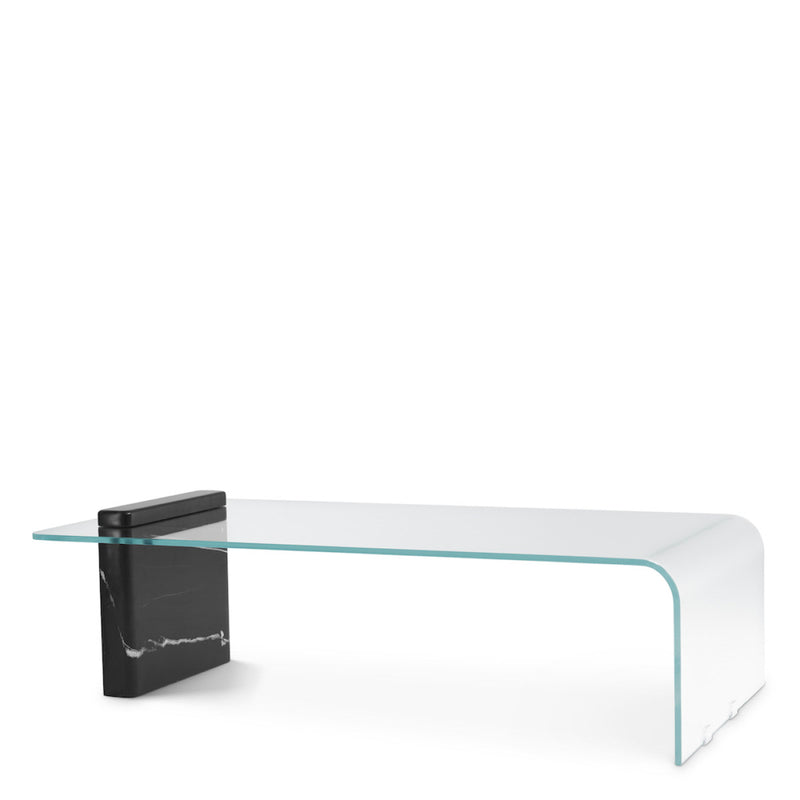
A third stone category — polished dark stone — reads differently from both. The Stonecrest coffee table uses dark stone as structural columns beneath a clear glass top. At this level of polish, the material looks almost lacquered; the contrast against glass and pale upholstery is stark and intentional. This is stone used architecturally. It suits rooms that already have hard geometry: coffered ceilings, paneled walls, a rug with a strong grid pattern.
The Cocktail side table shows how brass and travertine can occupy a single piece without competing. Its C-form base is in brushed brass — restrained and structural — while the top is a flat travertine slab with visible natural grain. The two materials reinforce each other: the warmth of the stone grounds the brass; the precision of the metal frame keeps the stone from reading as rough. This kind of material pairing — where each element makes the other look better — is one of the design principles Eichholtz returns to consistently.
Natural Wood: Oak, Walnut, and the Grain Question
Not every Eichholtz piece is metal and stone. Across the collection, a quieter material palette includes solid oak, walnut veneer, and warm-toned wood frames. Wood appears most often in pieces you'll touch directly — drawer fronts on nightstands, console bases, desk surfaces — where the grain and texture matter in a way they don't when a material is purely visual.
Light oak with horizontal grain reads as open and casual; dark walnut with straight grain reads as more deliberate and formal. Eichholtz tends to use wood as a secondary material — a drawer front on a brass-legged nightstand, a veneer panel beneath a stone top — rather than as the dominant finish. This keeps wood from competing with metal and stone in a room, while still providing material warmth at the points where someone is closest to the piece.
If your room already has a dominant warm wood element — a herringbone floor, paneled walls, a heavy dining table in walnut — the Eichholtz wood pieces can be a quiet extension of that language. If you're working in a room without wood, introducing a single piece with a wood drawer front or frame can soften an otherwise hard material palette of stone and metal without changing the room's overall register.
Choosing a Finish: A Starting Framework
A useful starting point: look at what's already fixed in the room before selecting furniture finishes. Door hardware, light fixtures, faucet handles, and architectural trim all carry a finish that the furniture should acknowledge rather than fight. If your fixed elements are warm — oil-rubbed bronze, aged gold, warm wood — brass pieces will feel like they belong. If your fixed elements are cool — brushed nickel, chrome, white stone — dark metal or glass-and-stone combinations tend to read better than layering more warm metal into the room.
Scale is the second variable. Brass at the scale of a small side table adds warmth and detail without demanding attention. Brass at chandelier scale becomes an architectural decision — it shapes how the room reads from every angle, and it can't be undone easily. Finish decisions at scale deserve a showroom visit rather than an online order, which is exactly what the Eichholtz Las Vegas showroom is built for.
For designers specifying on a project — residential, hospitality, or commercial — the showroom floor at Tivoli Village carries representative pieces across the major finish families. A studio visit lets you compare how vintage brass, antique brass, and burnished gold read in the same room, with real light, next to pieces in stone and upholstery. Most finish decisions that look obvious in a spreadsheet reveal their complexity when you put two materials side by side in a real space.


See the Finish in Person
Photography communicates shape and proportion well. It's not reliable for material texture — how cast brass catches raking light, the temperature of travertine under your hand, or the depth of a polished stone surface at close range. These are decisions that reward a visit, and the Eichholtz Las Vegas showroom at Tivoli Village carries pieces across the full material palette on the floor, not behind glass.
In-stock pieces ship from the Eichholtz warehouse network within two to four weeks — which compares favorably to the twelve to twenty-four weeks typical of made-to-order luxury furniture. If you're mid-project and a finish decision is holding things up, coming in to resolve it against real pieces is faster than waiting for samples to arrive.
Design Access at the Showroom
Trade clients and designers are welcome to schedule a dedicated studio visit to work through finish and specification decisions.
Apply for Trade Access