Skip to content


A dresser or sideboard is one of the hardest-working pieces in a luxury interior. It holds what the room needs to function, anchors an empty wall, and gives you three feet of surface to style exactly as you choose. It does not call attention to itself. It just makes every room it enters better.
At Eichholtz Las Vegas, the dresser and sideboard collection spans one of the wider ranges we carry — in scale, material, and finish. From geometric hand-carved oak to mirrored antique panels framed in brass, each piece has a clear visual character. Choosing the right one is less about preference and more about reading the room you are placing it in.
The top of a dresser is one of the most carefully observed surfaces in any room — and one of the most rewarding to get right.
Where It Actually Lives
The dresser belongs in more rooms than most people use it. The assumption is that it is a bedroom piece — a place for folded clothes and a morning mirror. That is one application. In the way that luxury interiors are planned today, the dresser shows up in four distinct placements, and only one of them is the bedroom.
- Living room. Opposite the seating, on the longest available wall. This is where the dresser earns its place when there is no fireplace to anchor the room. The surface becomes the focal point of the wall; the storage stays hidden behind closed doors. A dresser here operates visually the same as a built-in — without the permanence or the construction cost.
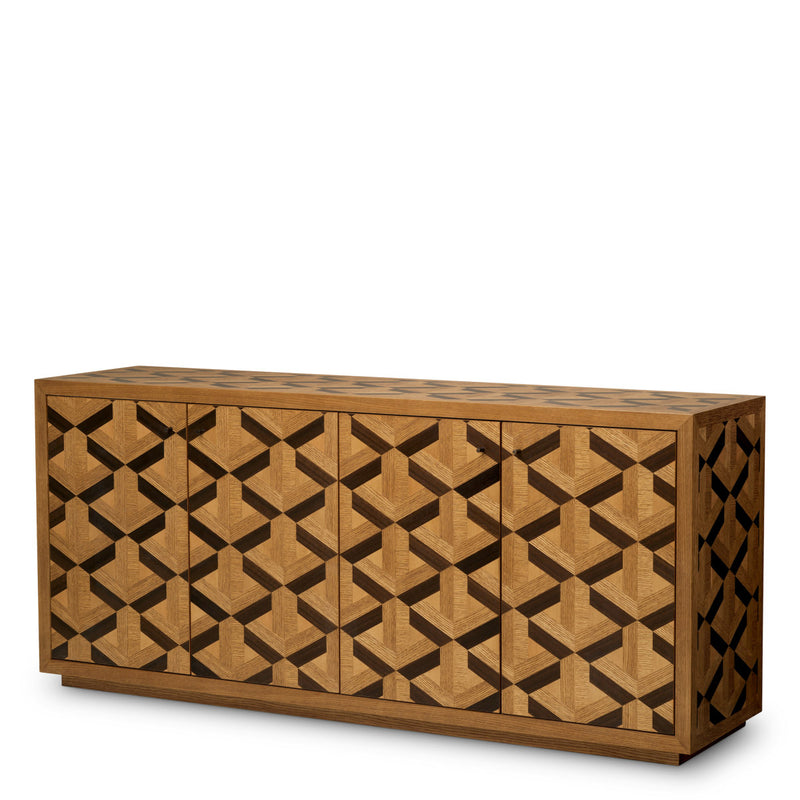
- Dining room. As a sideboard, it replaces the traditional buffet. Serving pieces, table linens, candles: all of it disappears when dinner is over. The piece grounds the dining room even on non-dining days. Many of the pieces in the Eichholtz collection — including the Nottingham and the Rubicon — are dimensioned for exactly this application.
- Hallway or entry. A dresser here solves the accumulated-objects problem elegantly. Keys, mail, the items that collect near the door — they go inside. What you see is the styled top: a lamp, a plant, a couple of objects. The hallway starts to look considered rather than lived-in.
- Primary bedroom. On the wall beside or opposite the bed, across from the closet. This is the traditional placement, still the right one when the bedroom warrants proper furniture rather than flat-pack storage. A dresser in this context reads as designed furniture — as case goods with a clear visual intention — rather than as utility.
The rule across all four placements is scale. A dresser sized too narrow for its wall reads as if it wandered in from a smaller room. One sized too wide closes the space and blocks circulation. For most rooms, the right width falls between fifty and seventy-two inches. The Rubicon is sixty-three inches wide — proportioned to anchor a standard wall while leaving comfortable walking room on either side.
The Three Visual Directions
The Eichholtz dresser and sideboard collection is not organized around a single aesthetic. It runs in three distinct visual directions, which is useful when you are trying to match a piece to a room that already has a character of its own.
The first direction is geometric and organic. Pieces like the Rubicon have pattern routed directly into the wood — interlocking angular shapes cut into solid oak, creating a dimensional surface that reads differently in morning light than it does in the evening. The finish is warm, close to the grain, with nothing between you and the material. These pieces work well in rooms that already carry layering — a textured rug, upholstered walls, a patterned fabric on the seating — because the dresser adds visual depth without adding another color to manage.
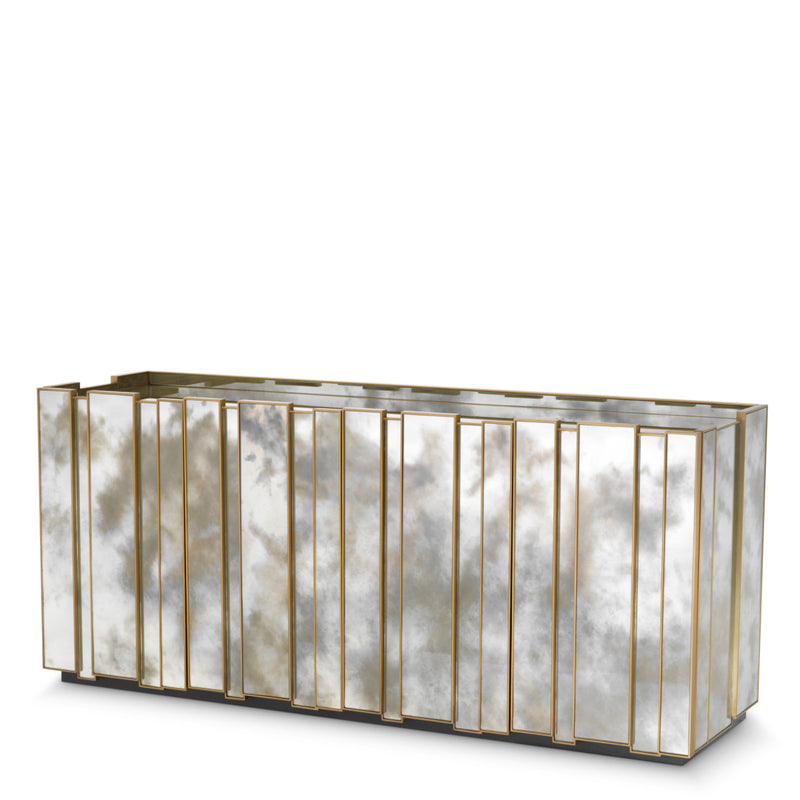
The second direction is mirrored and glamorous. The Nottingham is built from panels of antiqued mirror set within an antique brass frame. The piece reflects the room around it, which is one of the more practical qualities a piece of furniture can have: in a smaller dining room or a hallway, the reflection makes the space feel larger without any structural change. The antique quality of the mirror — slightly amber, with some variation in the surface — means it flatters rather than reproduces clinically. This approach has an Art Deco lineage. It reads as a quiet statement in a room that is otherwise neutral.
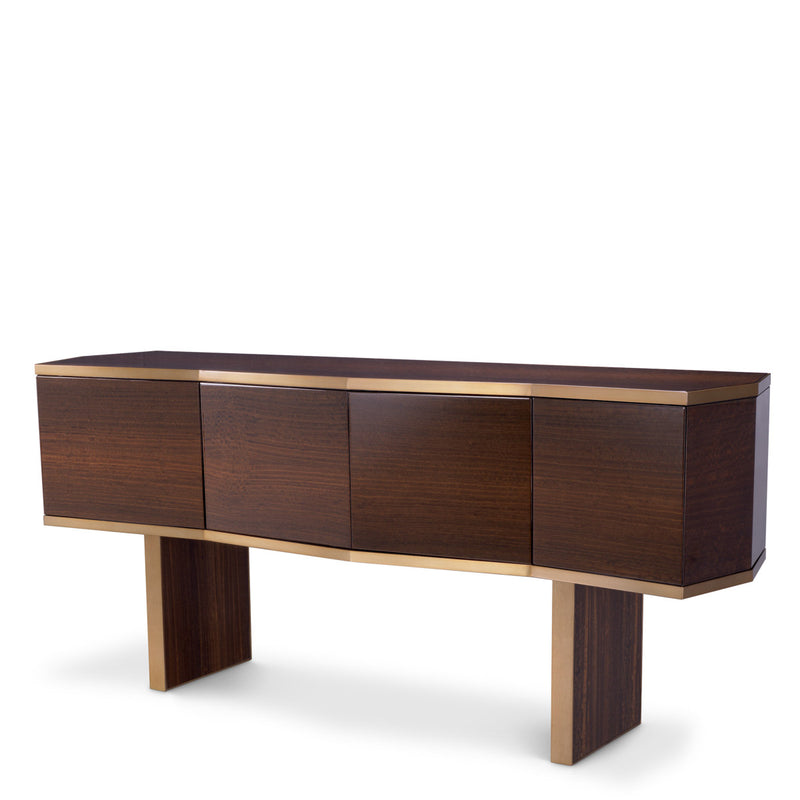
The third direction is dark and architectural. The Xenon is lacquered dark wood — nearly black, with a high sheen — elevated on antique brass legs with matching hardware detail at the front. The contrast between the dark body and the warm metal is the point. These pieces need a room that gives them space to land: cream upholstery, a neutral rug, walls with texture rather than pattern. The dresser becomes the room's single strongest visual note.

Sizing for the Room
The most common mistake with a dresser is ordering without measuring the wall it is going on. A wall that looks wide in person often has a sight line from an adjacent room, or a doorway, that constrains what can go there. A wall that looks narrow sometimes opens into a generous run once the measuring tape is out.
The standard approach: a dresser should occupy sixty to seventy-five percent of the wall width between any two adjacent architectural features — doorways, windows, or built-ins. Leave at least eighteen inches of breathing room on each side where the layout allows. The piece should have a visual relationship to the space it occupies, not sit marooned in the middle of a ten-foot run or squeezed between two door casings with six inches of wall showing on each side.
Height matters too. Most Eichholtz dressers and sideboards fall between thirty and thirty-six inches tall — the right height for styling at standing level, for serving in a dining room, and for hanging art above without the art crowding the ceiling. As a general guide, art hung above a dresser should clear the top surface by eight to twelve inches, with the art's horizontal center at approximately sixty to sixty-four inches from the floor. This keeps the grouping reading as a single composed moment rather than as a dresser with something hung too high above it.
Styling the Top
The surface of a dresser takes whatever you put on it. That is the opportunity and also the risk.
The most reliable structure: one tall element, one medium, one low. A sculptural table lamp on one end provides the vertical anchor. A plant — a fiddle-leaf fig branch cut short, an areca palm, something with actual scale — adds the live element. A stack of coffee-table books with a small ceramic object on top provides the horizontal spread across the center of the surface. This three-tier logic works on any dresser, in any room.
Resist filling the full width. A dresser styled edge to edge looks like a display shelf. Leave five to eight inches of empty surface at each end. The negative space makes the objects read as intentional rather than accumulated.
Proportion between the lamp and the dresser matters more than most people account for. A lamp sized for a side table gets lost on a sixty-inch credenza — it reads as small and unconfident. The right lamp for a dresser is taller than you would expect, often thirty to thirty-six inches from base to shade top. Most of the larger-format table lamps in the Eichholtz collection are designed with this scale in mind.
Eichholtz accessories — ceramic vases, lacquered boxes, sculptural candleholders, decorative objects — are designed for use at dresser and console scale. They are larger than they appear in individual product photography, which is intentional: they need to read from across the room.


Delivery and Lead Time
The dresser and sideboard collection at Eichholtz Las Vegas is available with two-to-four week delivery for in-stock pieces — meaningfully faster than the twelve to twenty-four weeks that is standard on made-to-order case goods from most sources. If you are working against a move-in date or a project timeline, asking about in-stock availability at the start rather than the end of the conversation makes the difference. Our team can confirm stock at the time of inquiry.
Worth Seeing in Person
The dresser collection is one of those categories that gains something from being seen. The Rubicon's geometric carving looks like photography until you see the depth of the routing in person — the shadows the facets cast change through the day. The Nottingham's mirror quality is different in morning light than in the evening. The Xenon's lacquer has a depth that photographs render as flat. All three arrive looking larger and better than their product images suggest. We invite you to visit us at Tivoli Village in Summerlin, or to bring a floor plan and let us walk you through scale and placement options.
Trade Access
Interior designers can access trade pricing on the full Eichholtz catalog through our Designer Trade Program.
Apply for Trade Access