Skip to content


Dining chairs are the most-used furniture in a home. You sit in them every day, linger at the table after meals, and pull extras in when guests arrive. And yet most people choose them last — an afterthought to the table. The result is a room that almost comes together.
At Eichholtz Las Vegas, dining chair decisions come up in nearly every showroom visit, whether the customer is a homeowner updating a worn set or an interior designer specifying a complete dining room from scratch. The choices involve more variables than most people expect: scale, silhouette, upholstery, leg finish, and the balance between side chairs and armchairs. Here is how to think through each of them.
The dining chair is where the room finally sits down — and the decision shows.
Scale: the math that matters first
The relationship between a dining chair and a table is a physical one. A standard 30-inch table calls for a chair with a seat height in the 17- to 18-inch range — that 10- to 12-inch gap between seat and tabletop is the standard for comfortable dining. Too tall and guests feel pressed against the surface; too short and the posture becomes awkward across a long meal.
Seat depth is the next variable. A deep seat — 22 inches or more — suits a relaxed kitchen table where people settle in for conversation. A shallower seat, in the 19- to 21-inch range, works better at a formal dining table where you naturally sit more upright. Seat width closes the equation: plan for at least 24 inches of table length per chair so guests have room at the shoulder. A standard 96-inch table seats four comfortably with space to spare, or six if the chairs are narrow.
One variable that often surprises people: clearance from the back of a pulled-out chair to the nearest wall, cabinet, or buffet behind it. Allow at least 36 inches from the edge of the table seat rail to the wall for guests to push back and stand comfortably. In tighter dining rooms, armless side chairs — which require less lateral clearance — make the room more livable at the table.
- Side chairs versus armchairs. A uniform set of side chairs reads clean and deliberate. Adding two armchairs at the heads of the table introduces visual hierarchy — a cue that the room was considered rather than assembled. The armchairs do not need to match the side chairs exactly; a shared leg finish or upholstery fabric is enough to tie the set together.
- Upholstered seats versus frame-forward designs. Fully upholstered dining chairs — padded seat and back — add warmth and comfort, especially for meals that run long. Frame-forward designs with a minimal seat pad read lighter and let the table remain the dominant piece. Many Eichholtz dining chairs sit between these two: an upholstered seat and back set within a brass, bronze, or lacquered frame that connects the chair to other metals in the room.
- Visible legs versus covered legs. Chairs with exposed tapered legs, slender metal frames, or natural wood feel lighter on the eye and easier to move around. Fully upholstered chairs with hidden legs read more formal and more substantial — they work well in generous rooms where scale is not a concern. In smaller dining spaces, visible legs almost always look better and keep the room from feeling crowded.

Fabric and finish: where daily wear shows
Dining chairs live hard. They absorb cooking air, catch spills, and hold the weight of daily use. The material choice is a practical one even in a formal room. Performance fabrics — tightly woven blends treated for easy cleaning — hold up better than open-weave bouclés or natural linens in heavy-use dining environments, though both are available in the Eichholtz range. Leather is the easiest surface to maintain and reads well in both contemporary and traditional dining rooms. It also develops a patina over time that softens the room rather than wearing it out.
Leg finish connects the chair to the rest of the room. Brass legs echo drawer pulls, a chandelier, or a bar cabinet — they read warm and classic and work especially well when the table has brass hardware or stone detailing. Blackened bronze or dark steel is more contemporary and recedes against a dark wood table. Natural wood legs — walnut, oak, or a lighter beech — introduce warmth and work in almost any color scheme. For rooms that tend cool or modern, a wood-leg chair grounds the space without adding visual weight. For rooms already carrying a lot of metal — hardware, fixtures, accessories — a wood-leg chair is often the right counterpoint.
Three dining chairs worth knowing
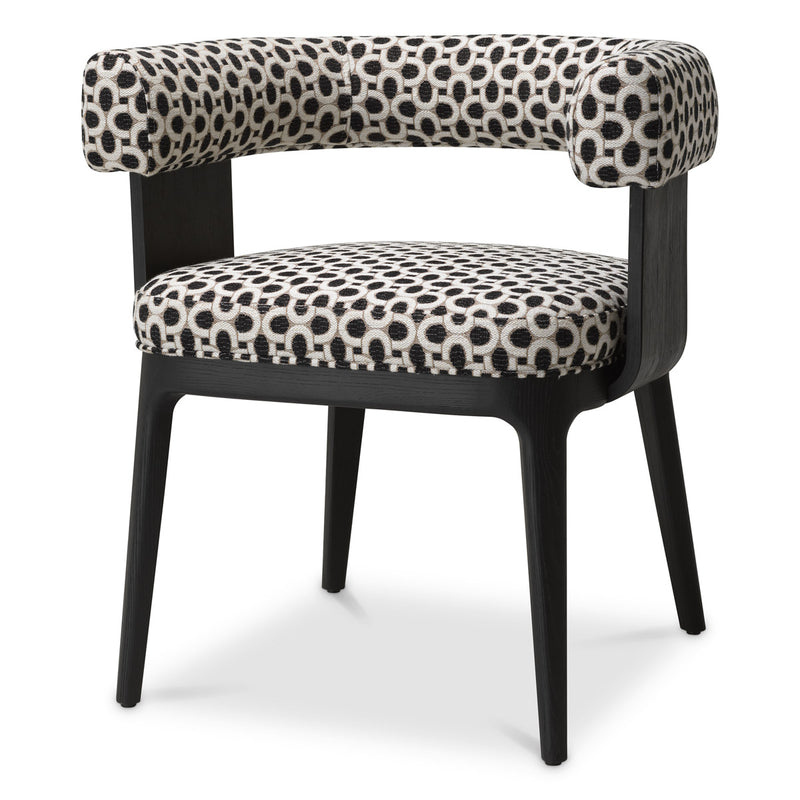
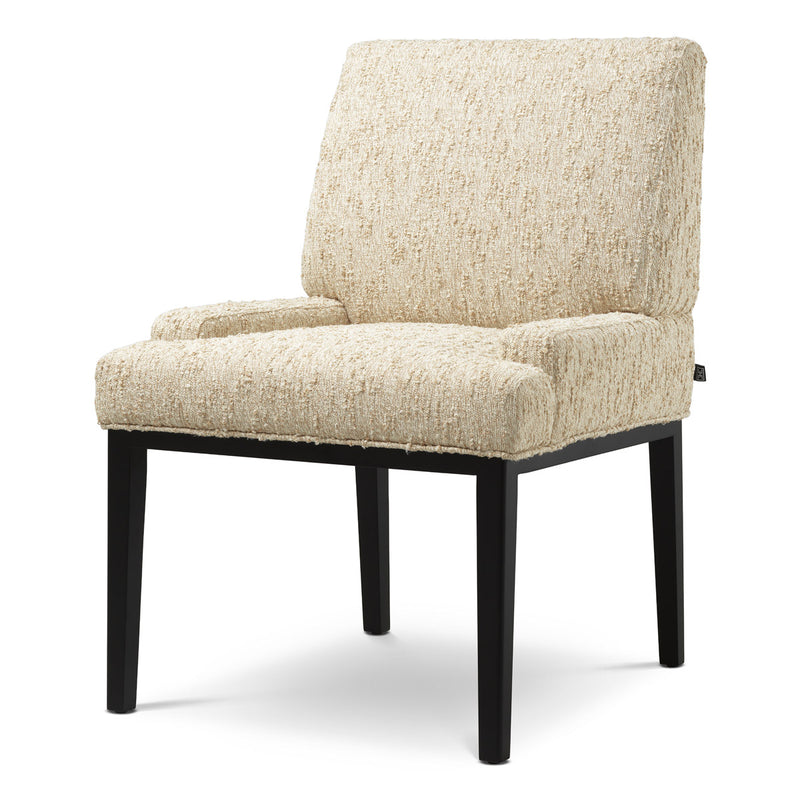
The Eichholtz dining chair collection spans a wide range of silhouettes — slim side chairs suited to compact dining rooms, fully upholstered pieces for larger formal settings, and arm chairs designed to anchor the heads of a long table. Three chairs that represent different ends of the decision:


The captain's chair question
Whether to add armchairs at the heads of the table is one of the most consistent points of indecision in a dining room specification. The practical rule is straightforward: a table 96 inches or longer can absorb two armchairs at the heads without crowding the sides. At 72 inches, the math gets tight, and a uniform set of side chairs usually makes the room feel more open.
When you do add them, proportions matter. A dramatically oversized armchair paired with delicate side chairs creates a visual mismatch — one that is difficult to undo once everything is in place. The armchairs should feel like a considered step up from the side chair, not a different design decision entirely. Sharing the same leg finish and upholstery fabric is usually enough to make the full set read as a whole, even when the silhouettes differ.
A loose-wrap arm, rather than a padded boxed arm, often works better at the dining table — it offers the presence of an armchair without the bulk. Many Eichholtz dining chairs are offered in both side chair and arm chair versions within the same family, which makes specifying a mixed set much simpler. The same upholstery and finish options carry through both versions.
Before you order
At Eichholtz Las Vegas, we keep dining chairs on the showroom floor in multiple upholstery options and finishes so you can sit in them before you commit. The difference between a 17-inch and an 18.5-inch seat height is immediately apparent in person; the difference between bouclé and a performance linen takes a closer look and a feel. Both are worth doing before a full set ships.
Most in-stock Eichholtz dining chairs deliver in two to four weeks from the warehouse network — significantly faster than the twelve to twenty-four week lead times standard on made-to-order custom pieces. If the specific fabric or finish you need is not on our floor, our team can pull the full specification range and order samples at no obligation. Trade designers can also speak with us about multi-chair project pricing and scheduling for larger residential, hospitality, or restaurant installations.
The showroom opens at Tivoli Village, Suite 160, in Summerlin this summer 2026. Come in and sit down before you decide.
See the Full Dining Chair Collection
Visit us at Tivoli Village to sit in the chairs before committing — or apply to the Designer Trade Program for full catalog access and trade pricing.
Apply for Trade Access