Skip to content


The dining room is the one space in a home where people actually sit together. Living rooms get reorganized around screens. Bedrooms are private. The dining table stays what it always was: a surface where everyone ends up at the same time, by invitation or by habit.
At Eichholtz Las Vegas, we carry the full dining room. Statement tables in marble, stone, brass, and solid wood. Dining chairs in leather, velvet, and performance fabric. Chandeliers scaled to fill the space above the table. What we see again and again is that customers who arrive thinking about a table leave having thought through the whole room — because each element shapes how the others read. This guide walks through the three decisions that matter most: the table, the chairs, and the overhead light.
The dining table is not just furniture. It is the reason the rest of the room exists.
Start With the Table
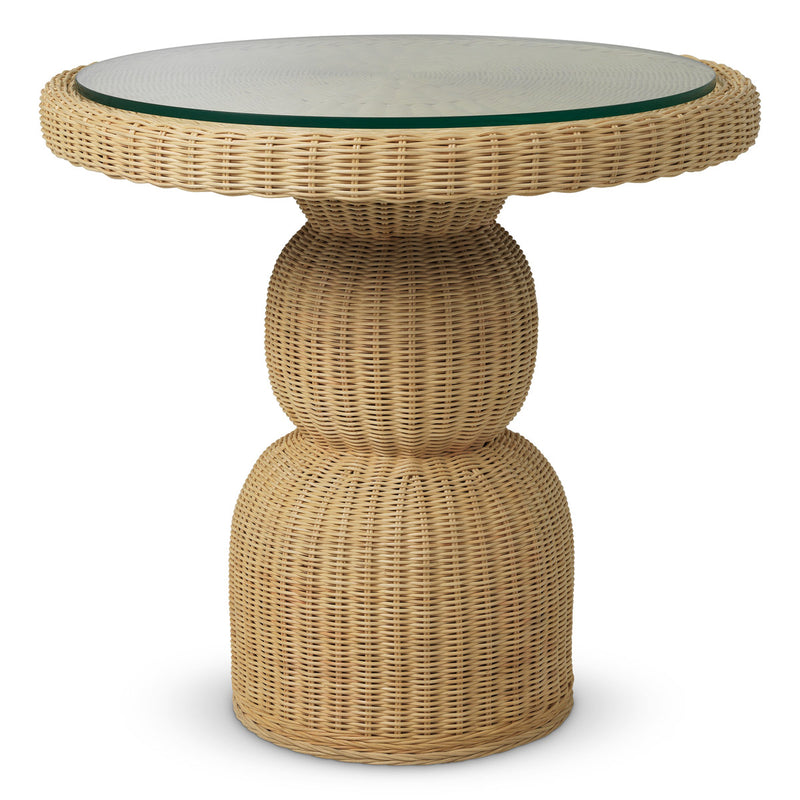
The table determines the proportions of everything else in the dining room. Get this right first, and the rest follows. A large rectangular table anchors a formal dining room; a round table creates a different dynamic — intimacy over hierarchy, no head of the table, no end seats. Both shapes appear throughout the Eichholtz collection in the same materials, so the shape decision does not limit your design language.
Before choosing a shape, measure the room carefully. A dining table needs at least 36 inches of clearance on all sides — enough for a chair to pull out and a person to walk behind it comfortably. In practice, 42 to 48 inches per side reads better. A 12-by-14-foot room, after clearances, comfortably holds a table of about 48 by 84 inches — a six- to eight-person rectangular table. A round table in that same room, 54 inches in diameter, seats six well.
- Rectangular tables suit long, narrow rooms and formal arrangements. The visual weight runs the length of the room. They seat the most people for large gatherings and can be extended with leaves — a 72-inch table with a leaf becomes a 96-inch table for ten.
- Round tables are better for smaller rooms and more casual dining. Every seat has the same relationship to every other seat. They do not extend easily and do not work well in narrow rooms, but in a square room or a breakfast alcove, a round table is often the right answer.
- Materials to consider. Eichholtz dining tables come in marble tops with metal bases, solid oak and walnut, lacquered surfaces, and stone-look composites. Marble is the statement and marks with use. Solid wood warms with age and takes a patina. Lacquer is easier to maintain than marble and reads nearly as sleek. The right material depends on how the table actually lives — daily family meals versus occasional formal entertaining.

The Chair Is What You Feel
A dining chair gets handled more than any other piece of furniture in a home. Guests pull it out, sit in it for an hour or two, push it back in. The finish will show wear. The seat will compress. The arm — or the absence of one — determines how close to the table people can actually sit.
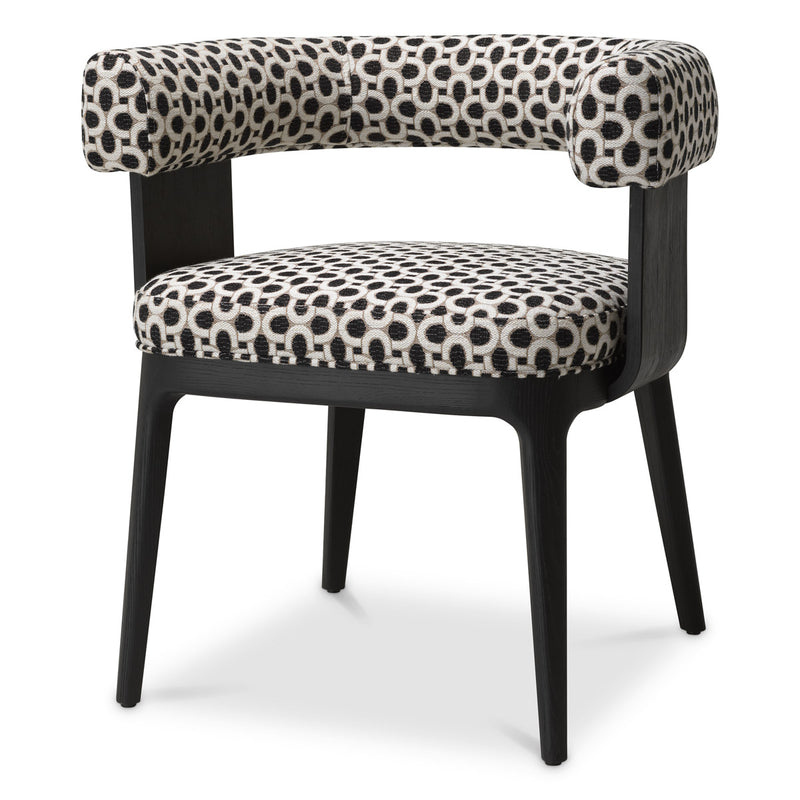
In the Eichholtz collection, dining chairs range from streamlined frames in performance fabric to fully upholstered pieces in velvet and leather. The choice comes down to three things: the role of the room, the upholstery durability needed, and the visual weight you want the chairs to carry relative to the table.
A fully upholstered chair in velvet or boucle reads beautifully in a formal dining room — one where meals are events rather than routines. For everyday use, performance fabric and leather clean more easily. Neither choice is wrong; they serve different rooms and different households.
The second question is arms versus no arms. Armchairs at the dining table are a traditional choice — the host chair, the carver. A full set of armchairs makes a generous, enveloping statement. A set of armless side chairs with two armchairs at the ends is the classic arrangement and works at almost any table length. Fully armless sets work especially well around round tables, where chair arms can otherwise crowd the person next to you.
One dimension people regularly overlook is seat height. Most Eichholtz dining chairs are designed for a standard 29- to 30-inch table. If your table sits lower or higher — some stone-top tables run at 28 inches, some counter-height tables at 36 — verify the seat height before ordering. The gap between the seat cushion and the underside of the tabletop should be roughly 10 to 12 inches.


The Chandelier Is What You See
In every other room, the overhead light is secondary — a task lamp, a floor lamp, or a sconce does most of the work, and the ceiling fixture fills in around the edges. In a dining room, the chandelier is the statement. It hangs directly above the table at a height where every person seated can see it. Its scale, its material, and its quality of light define the room more than any other single element.
Scale is the most common mistake — people go too small. The chandelier looks right in isolation in the showroom, gets installed, and disappears in the room. A reliable sizing rule: add the dining room’s length and width in feet. That combined number, converted to inches, gives you the minimum diameter for the chandelier. A 12-by-14-foot room (26 combined feet) calls for a chandelier at least 24 to 26 inches across. A 16-by-18-foot room calls for 34 inches or more. Larger reads better; smaller reads as an afterthought.
Hang the chandelier 30 to 36 inches above the table surface in a room with 8-foot ceilings. Add 3 inches per additional foot of ceiling height. At 32 inches above the table in a standard room, a chandelier is present without being intrusive. The goal is to light the table and the faces of the people sitting at it — not to light the walls, not to light the floor.
Material connects the chandelier to the rest of the room. A brass chandelier above a brass-based table creates a finish conversation between two pieces that may be 30 feet apart vertically, but the eye finds the connection. A crystal chandelier introduces formal sparkle that works in transitional and traditional dining rooms. Wicker and rattan fixtures read warmer and less formal — well-suited to an organic or coastal palette. The Eichholtz chandelier collection spans all of these directions at scales from intimate pendants to large multi-arm fixtures.
Putting the Room Together
The table, the chairs, and the chandelier are a conversation. They need to agree on the level of formality, the finish palette, and the visual weight they carry together.
A marble table with a brass base works with a brass chandelier because the finish repeats — the eye moves from the table base to the fixture and connects them without being told to. A dark walnut table reads warmer with chairs upholstered in cream or ivory; the contrast between dark wood and light fabric is exactly what keeps the walnut from feeling heavy. A round table benefits from a round or circular chandelier hung directly above it. A rectangular table works under a rectangular, linear, or elliptical fixture.
One combination that consistently works across different room sizes and styles: a statement rectangular or round table in stone or marble, four to six fully upholstered chairs, and a large brass chandelier hung 30 to 34 inches above the table. The three pieces agree on the level of formality. None of them competes for attention. The room feels complete.
In-stock Eichholtz pieces typically deliver in two to four weeks from the warehouse network — significantly faster than the twelve to twenty-four weeks that is standard on made-to-order luxury furniture. For the dining room, where you are choosing multiple pieces that need to arrive and be placed together, that timing matters. You can complete the room without staggering orders across a year.
Design Your Dining Room With Us
Trade members get access to the full Eichholtz catalog, dedicated design consultation, and trade pricing on every order.
Apply for Trade Access