Skip to content


A sofa without cushions is not quite finished. That's not a decorating opinion — it's a physical reality. Sofas are designed with cushions in mind: the proportions, the back height, the seat depth. Remove the cushions and what's left looks like it's waiting for something. This guide covers what to put back.
At Eichholtz Las Vegas, every seating arrangement in the showroom includes cushions. Not because we need to fill space, but because that's how a sofa actually lives. When you're choosing a sofa, you're also choosing a context — and cushions are part of that context. Getting them right is simpler than most people think.
Cushions are not decoration. They are the final instruction for how to use a sofa.
How many cushions is enough
The number depends on the size of the sofa, not on a rule. A standard three-seat sofa works well with three to five cushions — two at each end and one in the center, or two pairs with a single accent in front. A sectional can carry six to eight without looking overcrowded, because the extra length demands more visual weight to anchor it.
What you want to avoid is symmetry for its own sake. Two matching cushions at either end of a three-seat sofa reads as dated. Odd groupings feel more natural — three or five rather than two or four. And varying the size within a group adds depth: a larger square cushion behind a smaller rectangular cushion, or a lumbar cushion in front of a pair of larger squares.
- Two-seat sofa. Two to three cushions. A pair plus one different accent cushion at center reads well without overwhelming the seat area.
- Three-seat sofa. Three to five cushions. Work from the outside in — largest at the arms, smaller toward center.
- Sectional. Six to eight cushions. Mirror the arrangement on each arm, then fill the corner junction and seat line with smaller cushions.
- Accent chair. One cushion. That's usually enough. One well-chosen cushion does more than two generic ones.
Mixing patterns and textures
The most common mistake with cushions is buying a set — four identical cushions, the same pattern, the same scale. They look fine in a catalog photo and flat in a real room. What makes a grouping work is contrast: variation in texture, pattern scale, and color saturation.
A workable formula: one patterned cushion, one textured solid, one neutral. The pattern carries the personality. The textured solid — boucle, velvet, linen with a slight weave — adds depth without competing. The neutral gives the eye somewhere to rest. You can shift any of these up or down depending on the sofa and room.
Pattern scale matters as much as pattern style. A large graphic print and a small geometric can share a sofa well — they read at different visual distances. Two medium-scale patterns of similar density tend to fight. If you're mixing two patterns, make sure one is noticeably larger than the other.
Choosing cushions for your sofa color
The simplest approach: cushions that are two to three tones lighter or darker than the sofa fabric. A mid-gray sofa gets warmth from ivory or warm stone cushions. A cream boucle sofa can carry deep charcoal or warm amber without feeling too stark. Contrast is what makes the cushion visible — and the sofa read as styled rather than just occupied.
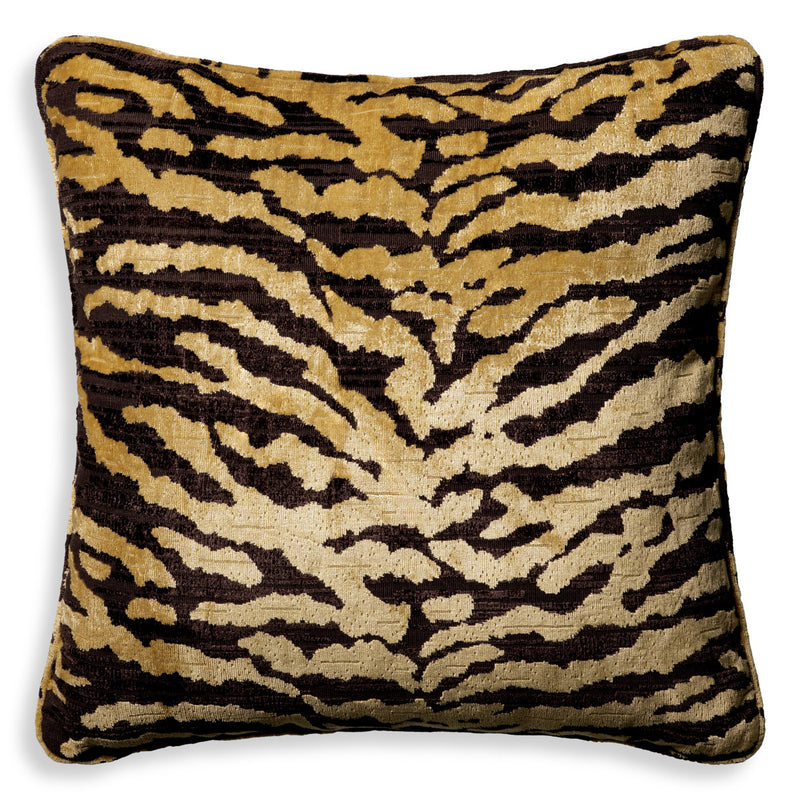
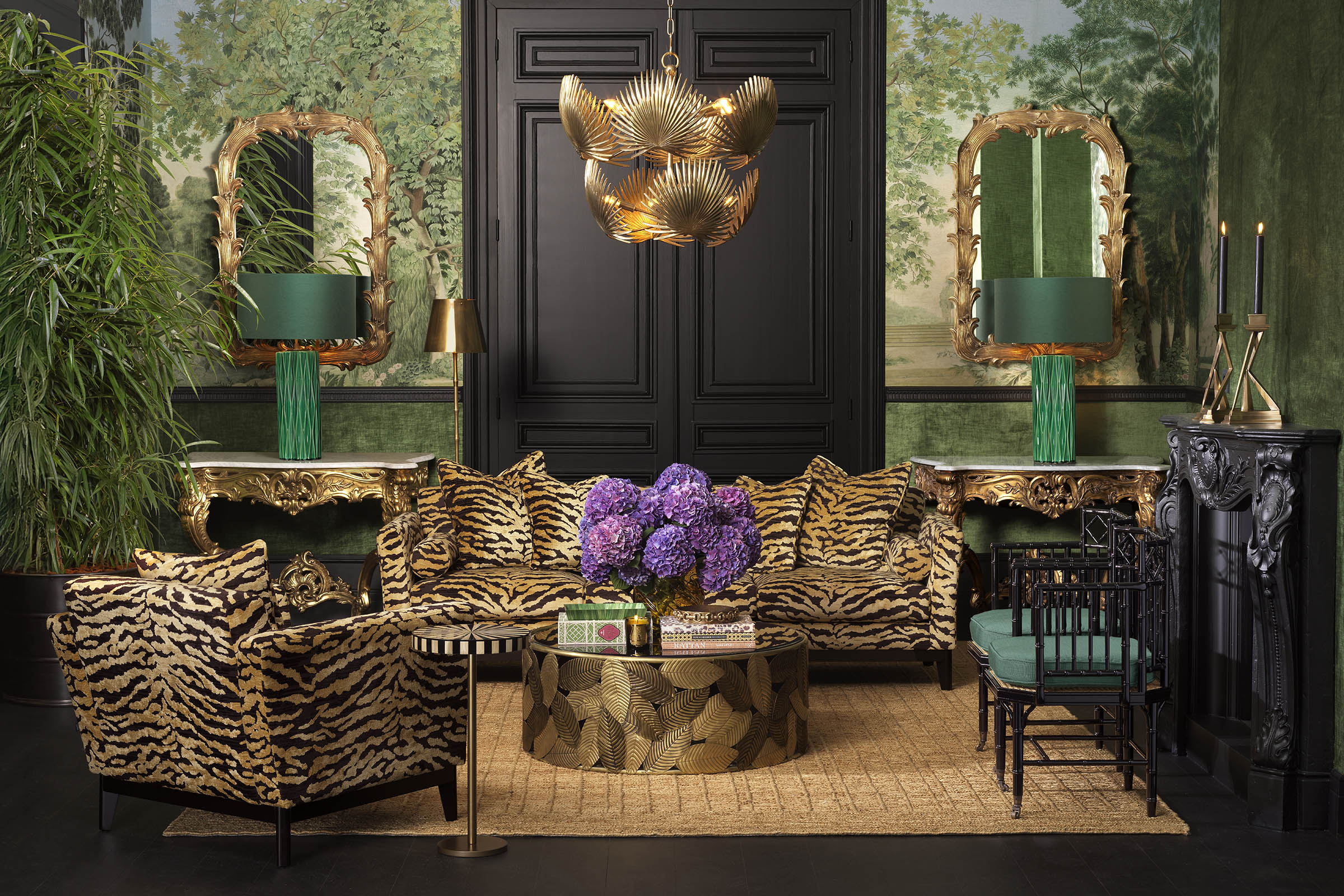
If the sofa is a statement piece — a bold color, a strong pattern, an unusual texture — the cushions should support it, not compete. A deep navy velvet sofa doesn't need a patterned cushion; a tonal navy linen with a slight sheen will look considered. A tiger-print sofa can carry matching Tigris cushions precisely because the print is already the statement — the cushions extend it rather than fight it.
For neutral sofas, cushions are where you introduce the room's color story. A gray sofa with terracotta, brass-toned, and ivory cushions tells a completely different story from the same sofa with dusty blue and forest green. The sofa is the canvas; the cushions are where the decision actually gets made.
Three Eichholtz cushions worth knowing
The Tigris line — named for the tiger motif — is among the most recognizable in the Eichholtz range. A tawny, graphic animal print that works in both bold and neutral rooms, depending on what surrounds it. The Sabrosa is at the opposite end of the register: a textural weave in an earthy palette, the kind of cushion that holds a layered arrangement together without drawing attention to itself. The Nami is compact and restrained — a smaller format that fills a lumbar position or anchors the center of a wider group without competing with the larger pieces around it.


Placement — how cushions actually live
Most people treat cushions as something you arrange once and leave. A more useful framing: cushions are adjustable, and they should look adjusted. An arrangement that's too perfect — every cushion square and equidistant — reads as untouched. The goal is something that looks lived-in but considered.
Stand a cushion slightly off-square rather than dead-straight on its edge. Let the front row lean slightly against the back row. If you have a lumbar cushion, place it slightly left or right of center rather than precisely in the middle. These are small shifts, but they move a sofa from arranged to inhabited.
Depth matters too. On a deep sofa, a cushion placed flat against the back takes up seat space and looks too formal. Angled slightly forward — so you're sitting on the front two-thirds of the seat with the cushion rising behind you — feels more natural. On a shallow sofa, the reverse applies: cushions should stand fully upright against the back, making the most of the visual height.
A note on outdoor cushions
Eichholtz also carries cushions designed for outdoor use — the Florent range in square, round, and rectangular formats. These are made for exposure: the fabric handles humidity, UV, and the kind of poolside conditions that destroy standard upholstery. If you're outfitting a terrace or loggia, specify outdoor-rated cushions from the start. Indoor cushions used outside hold moisture in the foam core and degrade quickly, even with occasional exposure.
Where to start
If you're starting from scratch: buy the sofa first, take a fabric swatch home, and choose cushions in a room with natural light. Fabric color shifts significantly between showroom lighting, natural daylight, and evening lamp light — and you want the cushions to work in the environment where the sofa actually lives.
If you're refreshing a room you already have: pull one existing cushion and bring it into the showroom. We can match against it, contrast against it, or build a new story around it. That's what the showroom is for.
Cushions are low-commitment by the standards of furniture. Changing them is cheaper than repainting and faster than reupholstering. It's one of the few places in a luxury interior where experimentation is genuinely low-risk.
Visit the Showroom
The full Eichholtz cushion range is on display at Tivoli Village, Suite 160. Come in and see the textures and patterns in person.
Apply for Trade Access