Skip to content


A console table does more work than almost any other piece in a home. It anchors an entry hall, gives a living room wall something to stand on, creates a focal point behind a sofa, and holds art, lamps, and objects without ever asking for attention. Yet it is often the last thing people think to buy — and one of the first things designers reach for.
At Eichholtz Las Vegas, we carry a range of console tables that span brass, marble, and sculpted glass. Each one approaches the same problem differently: how do you fill a wall without cluttering it? This guide walks through the placements where consoles shine, what to look for in a finish, and three pieces from the collection worth considering.
A console table isn't furniture you sit on or eat at. It's the piece that makes everything else in the room feel intentional.
Where a console table actually belongs
The obvious answer is the entry hall — and for good reason. The entry is the first and last impression of a home. A console with a mirror above it and a pair of lamps on either side is one of the most reliable vignettes in interior design. It creates symmetry, it holds keys and mail without encouraging clutter, and it gives visitors something to look at while they arrive.
But a console's most useful placement is often behind a sofa. When a large sectional or sofa floats in the middle of a room, the back of it becomes an awkward dead zone — a long horizontal surface with nothing behind it. A console table placed directly behind the sofa, flush with the sofa back, solves this immediately. You gain surface area for lamps, sculpture, or books, and the room feels grounded rather than adrift.
- Entry hall. The classic placement. A console table with a mirror above it anchors the space, creates symmetry, and defines the arrival moment. Pair with lamps on either side for warmth and balance.
- Behind the sofa. One of the most underused placements in residential design. A slim console — under 16 inches deep — sits flush against the sofa back and gives a floating furniture arrangement a sense of purpose.
- Dining room feature wall. A console on the long wall of a dining room holds serving pieces, bottles, and flowers while keeping the room's perimeter active. Art or a mirror above completes the moment.
- Bedroom alternative to a dresser. A console at standard height is a quieter option in a primary bedroom. It holds a lamp, a tray, a fragrance — and reads as considered furniture rather than storage.

The finish conversation
Material matters more for a console than for almost any other piece, because a console is mostly surface and silhouette. You see the material directly. A brass console fills a wall with warmth and weight. A marble-topped piece reads as precision. A sculpted glass console — especially one with a white or translucent finish — holds its shape without adding visual mass, which matters in a room that already has a lot happening.
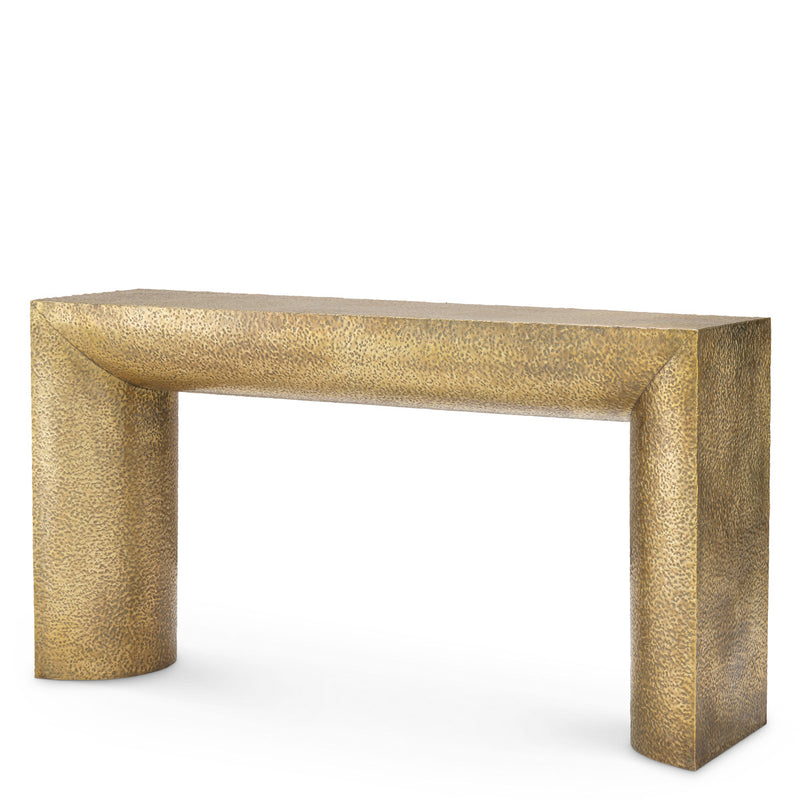
Brass is the most versatile of the three if a room has any warm light or aged metal in it — a brass chandelier, a bronze picture frame, a gold-toned mirror. The Drayton Console Table takes brass further than most: the entire piece is hammered vintage brass, including the legs and stretcher. The texture catches light differently depending on the angle, which is rare in a material that can sometimes read flat. At 55 inches wide, it's a piece that commands a wall rather than decorating it.
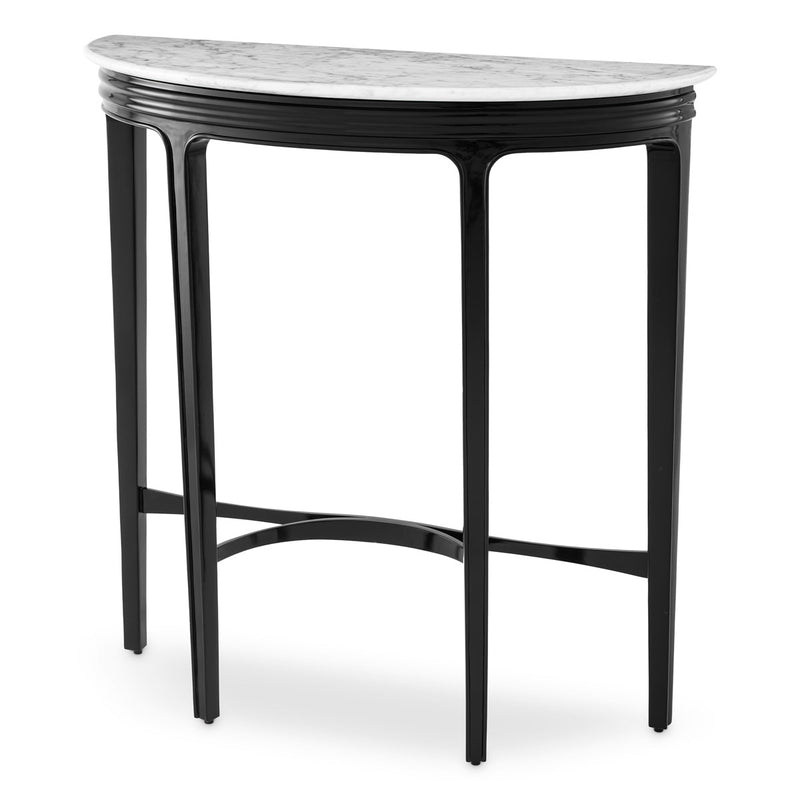
For rooms that want refinement without visual weight, the Rochefort Console Table offers a different logic. The base is piano black lacquer; the top is White Carrara marble. Compact at 32 inches wide, it reads like a considered punctuation mark — it belongs in a hallway where a full-width console would overwhelm, or on a narrow wall that needs something specific rather than something large.
Glass is a different proposal entirely. The Azura Console Table — its form described as mimicking the soft contours of stacked pebbles — is made entirely from glass in a white finish. It is substantial (the piece weighs 273 pounds), but reads as light. It suits spaces that want form over function: a living room vignette, a library alcove, or a primary bedroom wall where visual clutter is the main concern.


What to place on it
A console table earns its place through what it holds as much as what it looks like. The reliable brief: one lamp (or two flanking it for symmetry), one vertical element such as a tall vase or piece of sculpture, and one low element — a decorative object, a tray, a bowl. That rhythm — tall, medium, low — reads on a console the same way it reads on a shelf or a mantelpiece.
For a brass piece like the Drayton, the accessories can be warm and eclectic: a stone object, a leather tray, candleholders in varying heights. The hammered finish absorbs and reflects light rather than bouncing it, which means it tolerates variety without becoming cluttered.
For a marble-top console like the Rochefort, keep the surface lean. Marble does much of the work. A single lamp and one tall vase, and nothing else, reads correctly. Anything more starts to compete with the veining of the stone.
Sizing and placement specifics
The single number that matters most when placing a console table is depth. In an entry hall, anything deeper than 16 to 18 inches starts to narrow the walkway. In a living room behind a sofa, under 16 inches is the target — you want to clear the sofa back without creating a ledge that collects things. In a dining room along a wall, up to 18 inches works because circulation is one-sided.
Height is more forgiving. Standard console height runs from roughly 28 to 34 inches. For behind-sofa placement, the table height should sit within a few inches of the sofa back — typically 28 to 30 inches for most sofas. For entry halls, a taller console at 32 to 34 inches is easier to use and proportions better against a full-height wall with art above it.
The consoles in the Eichholtz collection cover this range. The Drayton and Azura run at 29 inches — suited for sofa-backing placement or a low entry console. The Rochefort reaches 33 inches — better suited to a hallway, dining wall, or any vignette where standing-height use is part of the design.
Getting this piece right
A console table is not a piece you buy because you have leftover wall space. It is one of the more specific decisions in a room because it defines a wall, holds the objects you've chosen to display, and sets the material tone for everything nearby. The right finish, the right width, the right depth for the intended placement — that alignment is what separates a wall that reads as designed from one that reads as merely furnished.
The pieces above are available to see at Eichholtz Las Vegas when we open this summer at Tivoli Village, Suite 160. For trade and residential clients, delivery on in-stock pieces typically runs two to four weeks from the Eichholtz warehouse network — considerably faster than the twelve to twenty-four weeks that's standard on made-to-order luxury furniture.
Trade access to the full collection
Interior designers can apply for trade pricing on all Eichholtz console tables and the complete catalog.
Apply for Trade Access